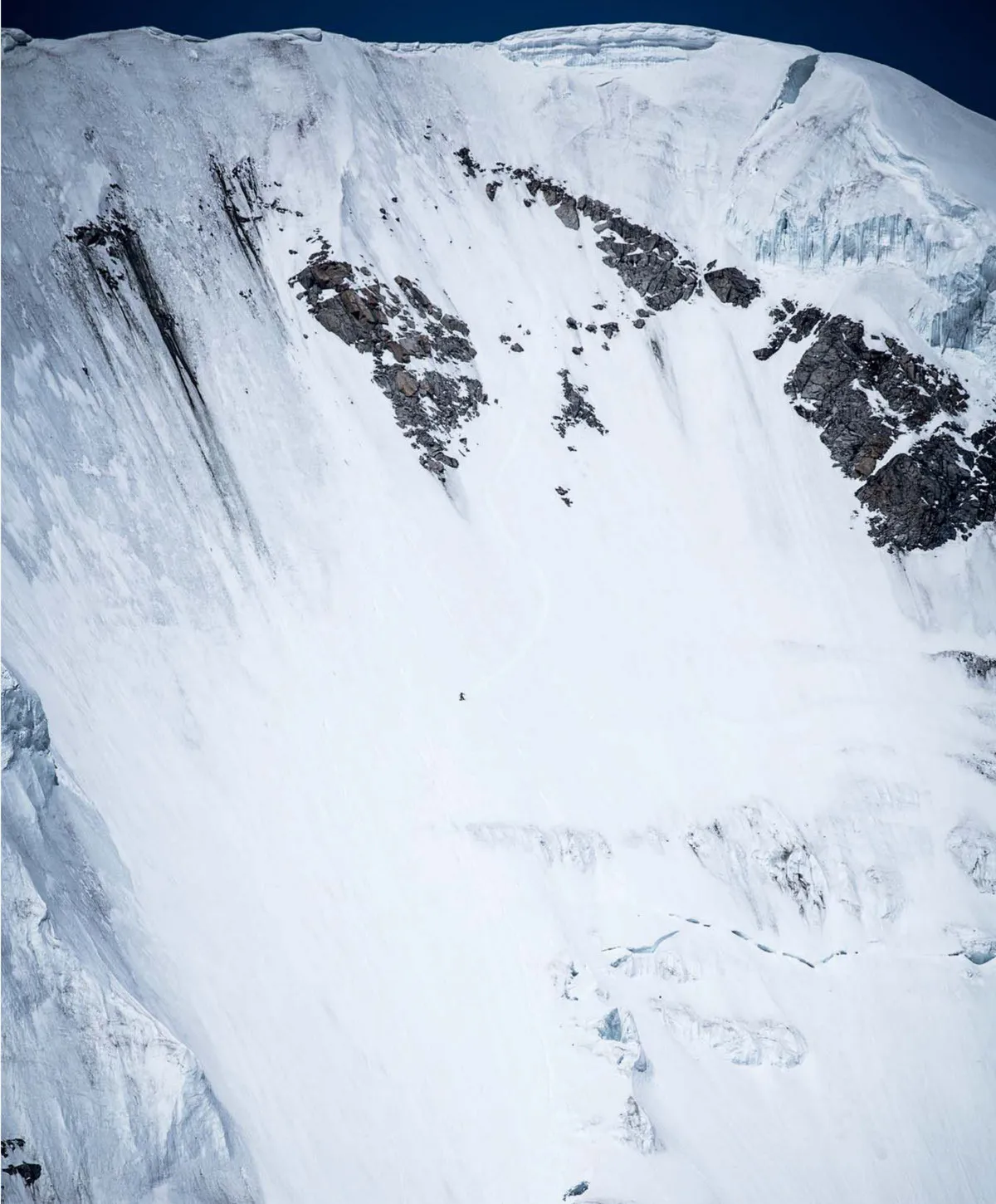
SLEEP WALKERS Still wrapped in my sleeping bag, I walk toward the edge of the ridge and see three dots slowly ascending. It’s 4:30 a.m. The rising sun be-gins to warm the mountain and alpenglow adds peace to it. My com-panions appear to be dancing on the snow. Soon they will disappear to the other side of the ridge toward China. Then I will lose all contact with them. Our two-way radios are of no use so close to the militarized borders with Russia, China and Kazakhstan. With a sketchy, satellite-phone weather forecast, no maps and two days from civilization, they will be truly on their own. It takes them four hours to reach the top of the mountain. Not long after that, a figure descends on a rope. It’s Stephan. The rappel is necessary. The first 150 feet are upon 60-degree ice. The rope is only 90 feet long, so Stephan unclips with just a single edge and a pair of ice axes securing him to the mountain. He slides carefully toward a long traverse to take him past massive seracs. His first turn is not one meant to be seen by any mother’s eyes, but he rides with strength and precision to the bottom of the ramp. Then he lays down on the flats because his legs can’t carry him any longer and basks in satisfaction. TICK TACK After Stephan rides the Khuïten, Rens rappels into the line, then changes his mind. It takes a lot of courage to not start the big traverse after already clipping out of the rope, but climbing back up to the summit is the right call for him. As soon as Rens is out of harm’s way, Sébastien takes his turn and engages in a half-hour battle with Khuïten before reaching safe ground at the bottom. Knowing the finish line does not lay at the bottom of the east face, we quickly but carefully make our way back from the bivouac, across the glacier and past crevasses torn wide open with meltwater. We ex-pend the last of our energy reserves climbing the moraine that sepa-rates the glacier from the hills behind it. Fourteen hours after waking, we crawl back to base camp, our bodies destroyed. Within five minutes of collapsing in our tents, a storm that had been chasing us hits with fury. Good timing is of the essence, and we’ve made it back not a mo-ment too soon. Slowly, we pack up camp and head back to civilization. More than one splitboard has been broken, an ice axe has disappeared, and our backpacks are trashed. We’ve lost a smart phone, wrecked a pair of poles, and a few sets of boots are beyond repair. Mongolia is a tough country. Nature knows no mercy in such a wild place. Eventually we arrive in Ulaanbaatar. We’re in no rush after a month spent on Mongolian time. There, we begin to unload and prepare for the journey home. Seku hands me my dusty board bag. It smells faintly of camels. I pull it aside and lie down on it, at peace. Khuïten Peak, at 14,350 feet, is the king of the Tavan Bogd. We never planned to ride its southeast face, but after staring at it for seven days, it gained allure. Khuïten means “cold” or “hard,” and it is a suitable name. Were we prepared? Honestly, no. Two of our splitboards were broken, but Mustafa and Woogie let us borrow theirs. Stephan and Sébastien knew the boards were too soft and too short. Yet when you know how to navigate serious mountains, the board under your feet shouldn’t hold you back. Stephan Verheij, midway through his descent. 072 THE SNOWBOARDER’S JOURNAL
The Snowboarder's Journal frequency 15.4: Page 72