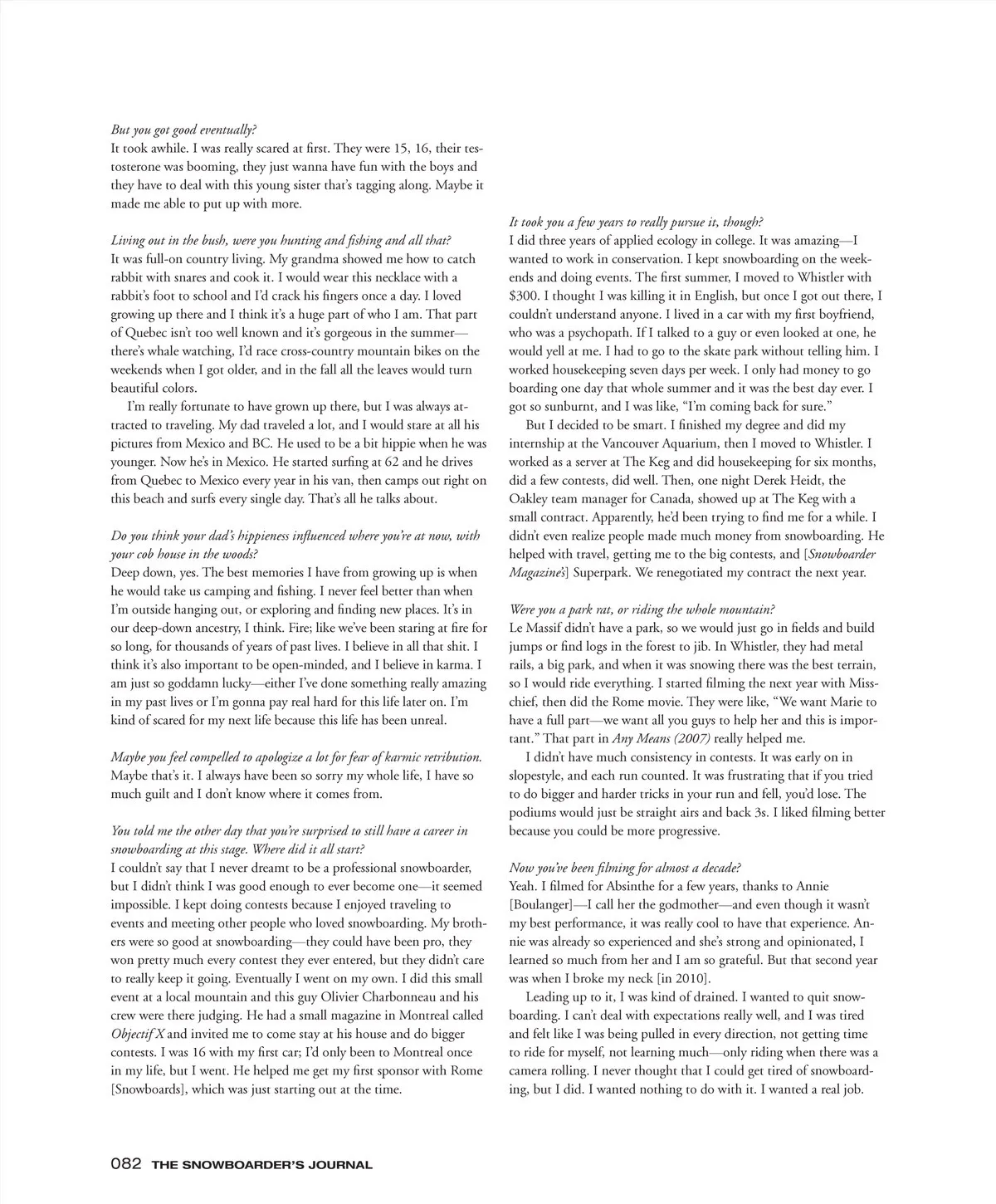
But you got good eventually? It took awhile. I was really scared at first. They were 15, 16, their tes-tosterone was booming, they just wanna have fun with the boys and they have to deal with this young sister that’s tagging along. Maybe it made me able to put up with more. Living out in the bush, were you hunting and fishing and all that? It was full-on country living. My grandma showed me how to catch rabbit with snares and cook it. I would wear this necklace with a rabbit’s foot to school and I’d crack his fingers once a day. I loved growing up there and I think it’s a huge part of who I am. That part of Quebec isn’t too well known and it’s gorgeous in the summer— there’s whale watching, I’d race cross-country mountain bikes on the weekends when I got older, and in the fall all the leaves would turn beautiful colors. I’m really fortunate to have grown up there, but I was always at-tracted to traveling. My dad traveled a lot, and I would stare at all his pictures from Mexico and BC. He used to be a bit hippie when he was younger. Now he’s in Mexico. He started surfing at 62 and he drives from Quebec to Mexico every year in his van, then camps out right on this beach and surfs every single day. That’s all he talks about. Do you think your dad’s hippieness influenced where you’re at now, with your cob house in the woods? Deep down, yes. The best memories I have from growing up is when he would take us camping and fishing. I never feel better than when I’m outside hanging out, or exploring and finding new places. It’s in our deep-down ancestry, I think. Fire; like we’ve been staring at fire for so long, for thousands of years of past lives. I believe in all that shit. I think it’s also important to be open-minded, and I believe in karma. I am just so goddamn lucky—either I’ve done something really amazing in my past lives or I’m gonna pay real hard for this life later on. I’m kind of scared for my next life because this life has been unreal. Maybe you feel compelled to apologize a lot for fear of karmic retribution. Maybe that’s it. I always have been so sorry my whole life, I have so much guilt and I don’t know where it comes from. You told me the other day that you’re surprised to still have a career in snowboarding at this stage. Where did it all start? I couldn’t say that I never dreamt to be a professional snowboarder, but I didn’t think I was good enough to ever become one—it seemed impossible. I kept doing contests because I enjoyed traveling to events and meeting other people who loved snowboarding. My broth-ers were so good at snowboarding—they could have been pro, they won pretty much every contest they ever entered, but they didn’t care to really keep it going. Eventually I went on my own. I did this small event at a local mountain and this guy Olivier Charbonneau and his crew were there judging. He had a small magazine in Montreal called Objectif X and invited me to come stay at his house and do bigger contests. I was 16 with my first car; I’d only been to Montreal once in my life, but I went. He helped me get my first sponsor with Rome [Snowboards], which was just starting out at the time. It took you a few years to really pursue it, though? I did three years of applied ecology in college. It was amazing—I wanted to work in conservation. I kept snowboarding on the week-ends and doing events. The first summer, I moved to Whistler with $300. I thought I was killing it in English, but once I got out there, I couldn’t understand anyone. I lived in a car with my first boyfriend, who was a psychopath. If I talked to a guy or even looked at one, he would yell at me. I had to go to the skate park without telling him. I worked housekeeping seven days per week. I only had money to go boarding one day that whole summer and it was the best day ever. I got so sunburnt, and I was like, “I’m coming back for sure.” But I decided to be smart. I finished my degree and did my internship at the Vancouver Aquarium, then I moved to Whistler. I worked as a server at The Keg and did housekeeping for six months, did a few contests, did well. Then, one night Derek Heidt, the Oakley team manager for Canada, showed up at The Keg with a small contract. Apparently, he’d been trying to find me for a while. I didn’t even realize people made much money from snowboarding. He helped with travel, getting me to the big contests, and [ Snowboarder Magazine’s ] Superpark. We renegotiated my contract the next year. Were you a park rat, or riding the whole mountain? Le Massif didn’t have a park, so we would just go in fields and build jumps or find logs in the forest to jib. In Whistler, they had metal rails, a big park, and when it was snowing there was the best terrain, so I would ride everything. I started filming the next year with Miss-chief, then did the Rome movie. They were like, “We want Marie to have a full part—we want all you guys to help her and this is impor-tant.” That part in Any Means (2007) really helped me. I didn’t have much consistency in contests. It was early on in slopestyle, and each run counted. It was frustrating that if you tried to do bigger and harder tricks in your run and fell, you’d lose. The podiums would just be straight airs and back 3s. I liked filming better because you could be more progressive. Now you’ve been filming for almost a decade? Yeah. I filmed for Absinthe for a few years, thanks to Annie [Boulanger]—I call her the godmother—and even though it wasn’t my best performance, it was really cool to have that experience. An-nie was already so experienced and she’s strong and opinionated, I learned so much from her and I am so grateful. But that second year was when I broke my neck [in 2010]. Leading up to it, I was kind of drained. I wanted to quit snow-boarding. I can’t deal with expectations really well, and I was tired and felt like I was being pulled in every direction, not getting time to ride for myself, not learning much—only riding when there was a camera rolling. I never thought that I could get tired of snowboard-ing, but I did. I wanted nothing to do with it. I wanted a real job. 082 THE SNOWBOARDER’S JOURNAL
The Snowboarder's Journal frequency 15.4: Page 82