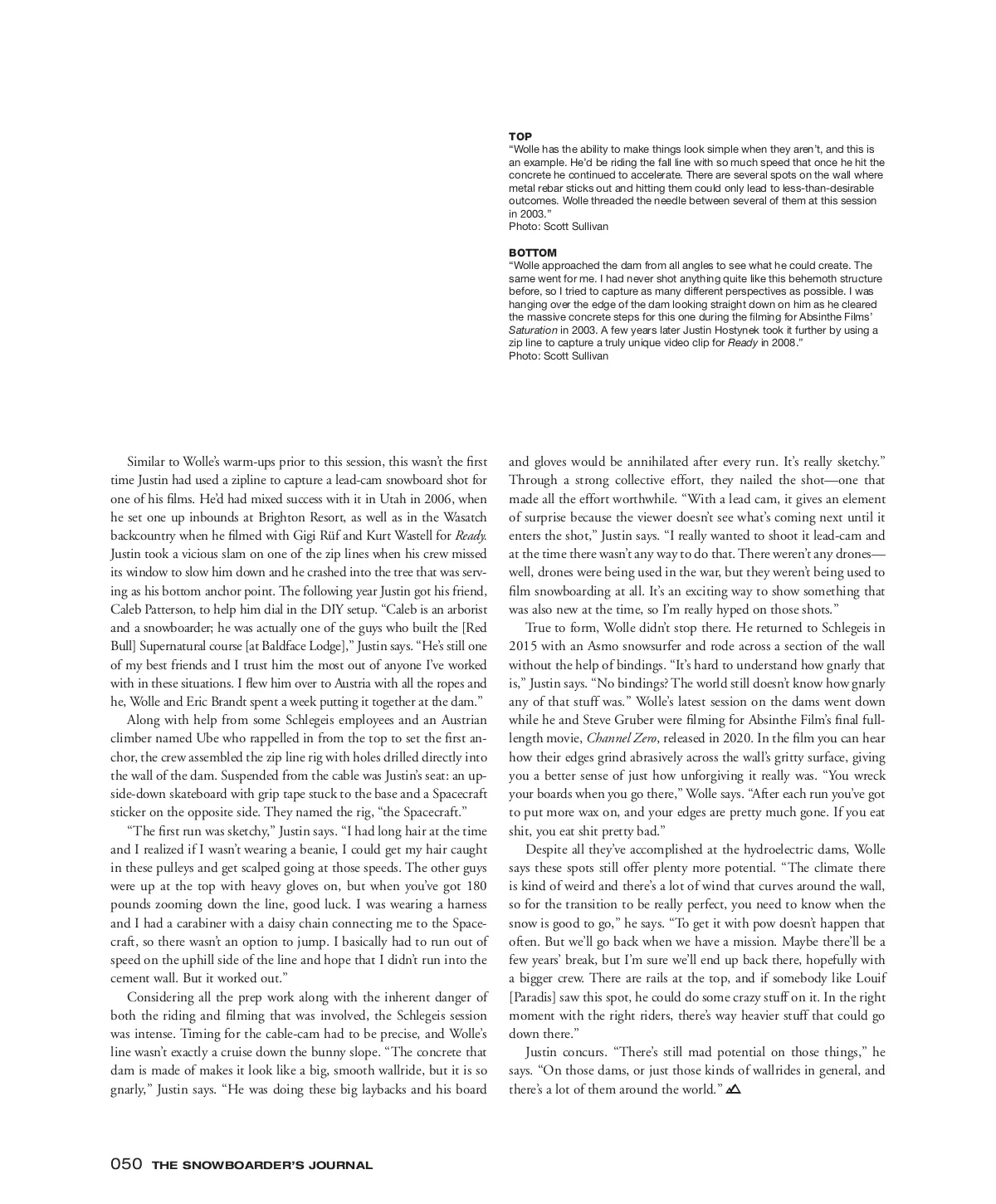
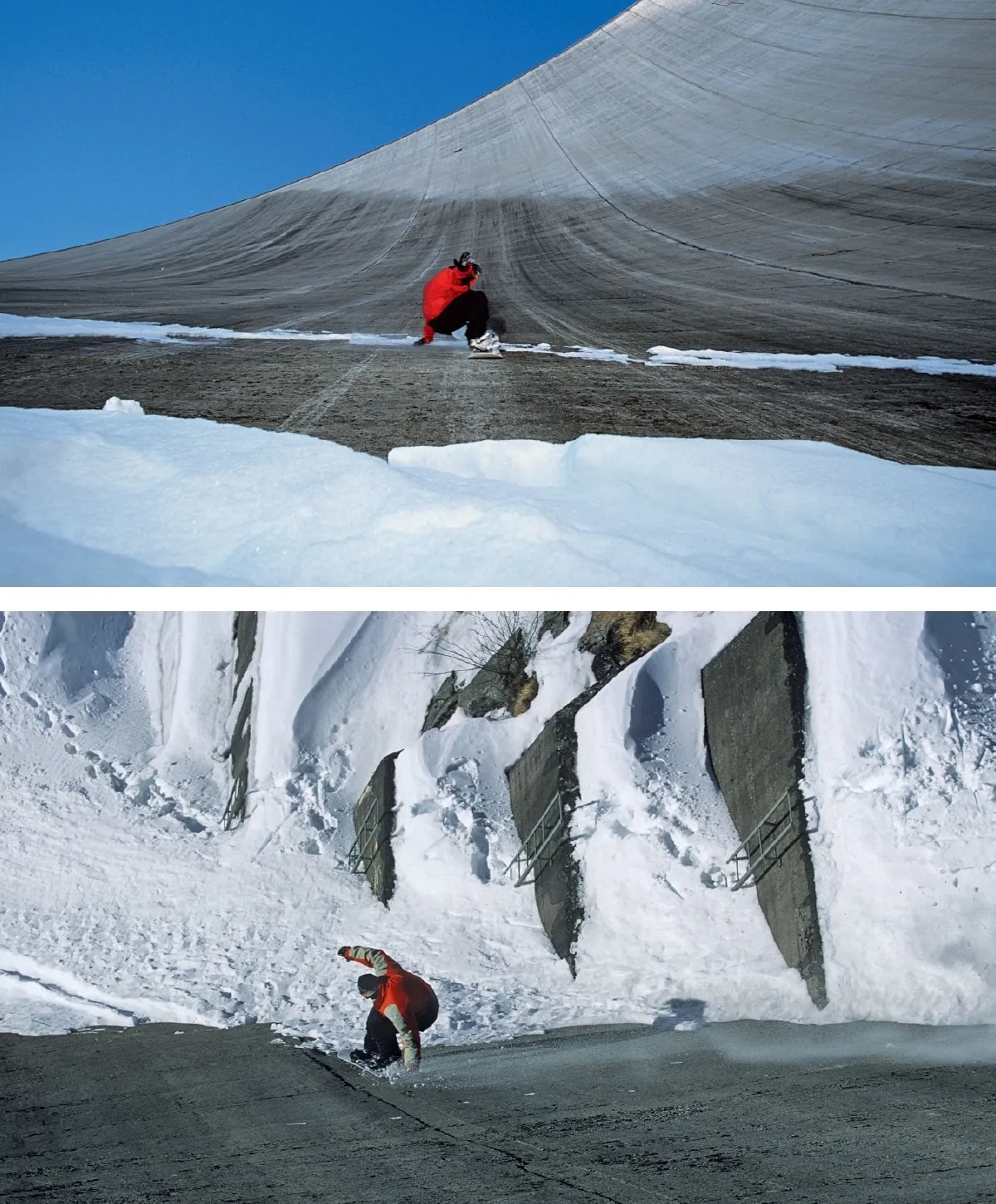
TOP “Wolle has the ability to make things look simple when they aren’t, and this is an example. He’d be riding the fall line with so much speed that once he hit the concrete he continued to accelerate. There are several spots on the wall where metal rebar sticks out and hitting them could only lead to less-than-desirable outcomes. Wolle threaded the needle between several of them at this session in 2003.” Photo: Scott Sullivan BOTTOM “Wolle approached the dam from all angles to see what he could create. The same went for me. I had never shot anything quite like this behemoth structure before, so I tried to capture as many different perspectives as possible. I was hanging over the edge of the dam looking straight down on him as he cleared the massive concrete steps for this one during the filming for Absinthe Films’ Saturation in 2003. A few years later Justin Hostynek took it further by using a zip line to capture a truly unique video clip for Ready in 2008.” Photo: Scott Sullivan Similar to Wolle’s warm-ups prior to this session, this wasn’t the first time Justin had used a zipline to capture a lead-cam snowboard shot for one of his films. He’d had mixed success with it in Utah in 2006, when he set one up inbounds at Brighton Resort, as well as in the Wasatch backcountry when he filmed with Gigi Rüf and Kurt Wastell for Ready. Justin took a vicious slam on one of the zip lines when his crew missed its window to slow him down and he crashed into the tree that was serv-ing as his bottom anchor point. The following year Justin got his friend, Caleb Patterson, to help him dial in the DIY setup. “Caleb is an arborist and a snowboarder; he was actually one of the guys who built the [Red Bull] Supernatural course [at Baldface Lodge],” Justin says. “He’s still one of my best friends and I trust him the most out of anyone I’ve worked with in these situations. I flew him over to Austria with all the ropes and he, Wolle and Eric Brandt spent a week putting it together at the dam.” Along with help from some Schlegeis employees and an Austrian climber named Ube who rappelled in from the top to set the first an-chor, the crew assembled the zip line rig with holes drilled directly into the wall of the dam. Suspended from the cable was Justin’s seat: an up-side-down skateboard with grip tape stuck to the base and a Spacecraft sticker on the opposite side. They named the rig, “the Spacecraft.” “The first run was sketchy,” Justin says. “I had long hair at the time and I realized if I wasn’t wearing a beanie, I could get my hair caught in these pulleys and get scalped going at those speeds. The other guys were up at the top with heavy gloves on, but when you’ve got 180 pounds zooming down the line, good luck. I was wearing a harness and I had a carabiner with a daisy chain connecting me to the Space-craft, so there wasn’t an option to jump. I basically had to run out of speed on the uphill side of the line and hope that I didn’t run into the cement wall. But it worked out.” Considering all the prep work along with the inherent danger of both the riding and filming that was involved, the Schlegeis session was intense. Timing for the cable-cam had to be precise, and Wolle’s line wasn’t exactly a cruise down the bunny slope. “The concrete that dam is made of makes it look like a big, smooth wallride, but it is so gnarly,” Justin says. “He was doing these big laybacks and his board and gloves would be annihilated after every run. It’s really sketchy.” Through a strong collective effort, they nailed the shot—one that made all the effort worthwhile. “With a lead cam, it gives an element of surprise because the viewer doesn’t see what’s coming next until it enters the shot,” Justin says. “I really wanted to shoot it lead-cam and at the time there wasn’t any way to do that. There weren’t any drones— well, drones were being used in the war, but they weren’t being used to film snowboarding at all. It’s an exciting way to show something that was also new at the time, so I’m really hyped on those shots.” True to form, Wolle didn’t stop there. He returned to Schlegeis in 2015 with an Asmo snowsurfer and rode across a section of the wall without the help of bindings. “It’s hard to understand how gnarly that is,” Justin says. “No bindings? The world still doesn’t know how gnarly any of that stuff was.” Wolle’s latest session on the dams went down while he and Steve Gruber were filming for Absinthe Film’s final full-length movie, Channel Zero , released in 2020. In the film you can hear how their edges grind abrasively across the wall’s gritty surface, giving you a better sense of just how unforgiving it really was. “You wreck your boards when you go there,” Wolle says. “After each run you’ve got to put more wax on, and your edges are pretty much gone. If you eat shit, you eat shit pretty bad.” Despite all they’ve accomplished at the hydroelectric dams, Wolle says these spots still offer plenty more potential. “The climate there is kind of weird and there’s a lot of wind that curves around the wall, so for the transition to be really perfect, you need to know when the snow is good to go,” he says. “To get it with pow doesn’t happen that often. But we’ll go back when we have a mission. Maybe there’ll be a few years’ break, but I’m sure we’ll end up back there, hopefully with a bigger crew. There are rails at the top, and if somebody like Louif [Paradis] saw this spot, he could do some crazy stuff on it. In the right moment with the right riders, there’s way heavier stuff that could go down there.” Justin concurs. “There’s still mad potential on those things,” he says. “On those dams, or just those kinds of wallrides in general, and there’s a lot of them around the world.” 050 THE SNOWBOARDER’S JOURNAL
The Snowboarder's Journal The Snowboarder's Journal 19.1: Page 50