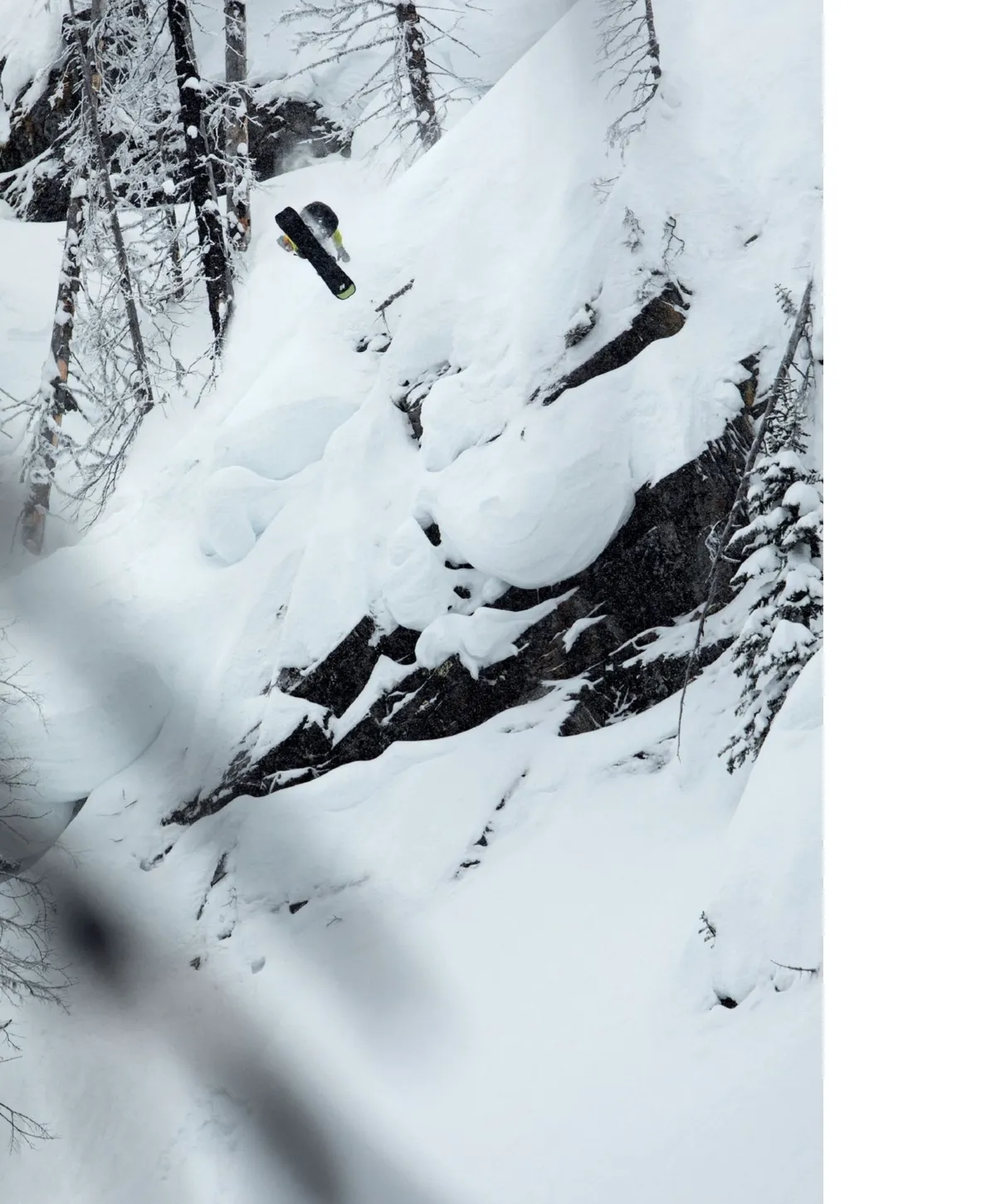
ANYTHING I WANT TO DO, I GIVE IT 100 PERCENT. THAT’S ALL I KNOW. LEFT Without a flake of doubt Sage is one of the strongest, most talented riders of his generation. Natural backside 360 near Revelstoke, BC, while filming for Halcyon , which won him Snowboarder Magazine ’s Rider of the Year in 2020. Photo: Jeremy Thornburg Sage has had skin in the game his whole life. Born in Coeur d’Alene, ID, he moved to Park City, UT, at the age of 5 and started competing locally by the time he turned 7. Only a few years later, during a trip to Mt. Hood, OR, with his family, Sage found himself in front of Quiksil-ver’s then-marketing manager, Brian Craighill. “My mom had footage of me, [older brother] Blaise and [younger sister] Kirra on a DVD,” he says with a laugh. “We showed it to Brian in the back of our car on one of those mini players. That’s when I met [Bryan] Fox too.” Ever since the start of Sage’s snowboard-ing career, his parents, Steve and Carol Ann, were down to facilitate. “They grew up surfing around California,” Sage explains. “My dad is from Burbank and my mom is from a similar area. My mom’s family would go down to San Onofre and camp when she was growing up, so they already kind of understood snowboarding when they came to the mountains. They were like, ‘We get this lifestyle. We can rock with it.’ When we started taking snowboarding more seriously it helped because they under-stood the process a bit from seeing it through their surf background. My dad still rides as much as he can; he’s 71. He’ll call me like, ‘Are you watching Pipeline right now? It’s firing!’ They’re shred-heads till the day they die.” Shred-heads, sure, but not your average. It’s worth noting that along with managing the operating room at one of Salt Lake City’s hospitals, Carol Ann would regularly run 70 to 80 miles per week and Steve juggled work in real estate with training for triathlons. When Sage’s riding started taking more seri-ous turns, his parents were on board for him to pursue it professionally, but not if he was going to half-ass it. That’s just the way they are, and presumably where Sage gets it from. During his teens Sage transitioned from pub-lic school to homeschooling to allow for more time to practice, travel and compete. “That’s how I was raised: Work hard,” he says. “With snowboarding it was like, ‘You’re going to work your ass off at it or let it be a hobby and go to school. We’re not going to just chill with you while you go to contests and get 30 th place.’ I never got yelled at by them for do-ing bad or anything like that; they just wanted to see the passion behind stuff. So, even to this day, I still operate on that. Anything I want to do, I give it 100 percent. That’s all I know.” With a tenacious drive to not only be the best he can be but, even more so, to be the best around, Sage’s competitiveness started showing during his youth. He’d sit slope side studying his competition, hike for hours on end to learn and improve upon progressive tricks and go far out of his way—and many times for broke—to try to be noticed. Sage’s sheer will to improve coupled with his unwavering commitment to see things through slowly but surely brought him to equal footing with riders he regularly surveyed—the same riders he’d eventually surpass. This led to success throughout various Dew Tours, X Games, Grand Prix and more, all while produc-ing video parts with both street and powder snowboarding. The kid had become a standout, primed for an opportunity of a lifetime. Despite his distaste for some of snowboarding’s struc-tured aspects, coaches especially, Sage set his sights on the 2014 Winter Olympics in Sochi, Russia, where slopestyle would be making its debut appearance. He saw it as being too good to pass up, and maybe he could have a positive impact on how the world views snowboarding. “I love competing, but going to FIS events, having to get on the national team and all that was sucking it out of me,” Sage says. “It was two different sides of snowboarding inside of me battling it out. I’d try to bring a little bit of the core, punk rock vibe into it, but in the end, I joined the team. Bill Enos was our coach. We butted heads at first and didn’t like each other. We had to have this big conversation about it. I ended up giving him a chance and it was re-ally helpful for me. I’m so glad I didn’t listen to other people and pull out of the Olympics. I’m glad I worked through it and really found myself in the process. It was like, ‘The world’s not perfect, but maybe we should just show up and show everyone what snowboarding is all about.’ Enos told me to just roll through the whole process as myself, and that was the best advice anyone gave me for a contest.” SAGE KOTSENBURG 045
The Snowboarder's Journal The Snowboarder's Journal 20.3: Page 45