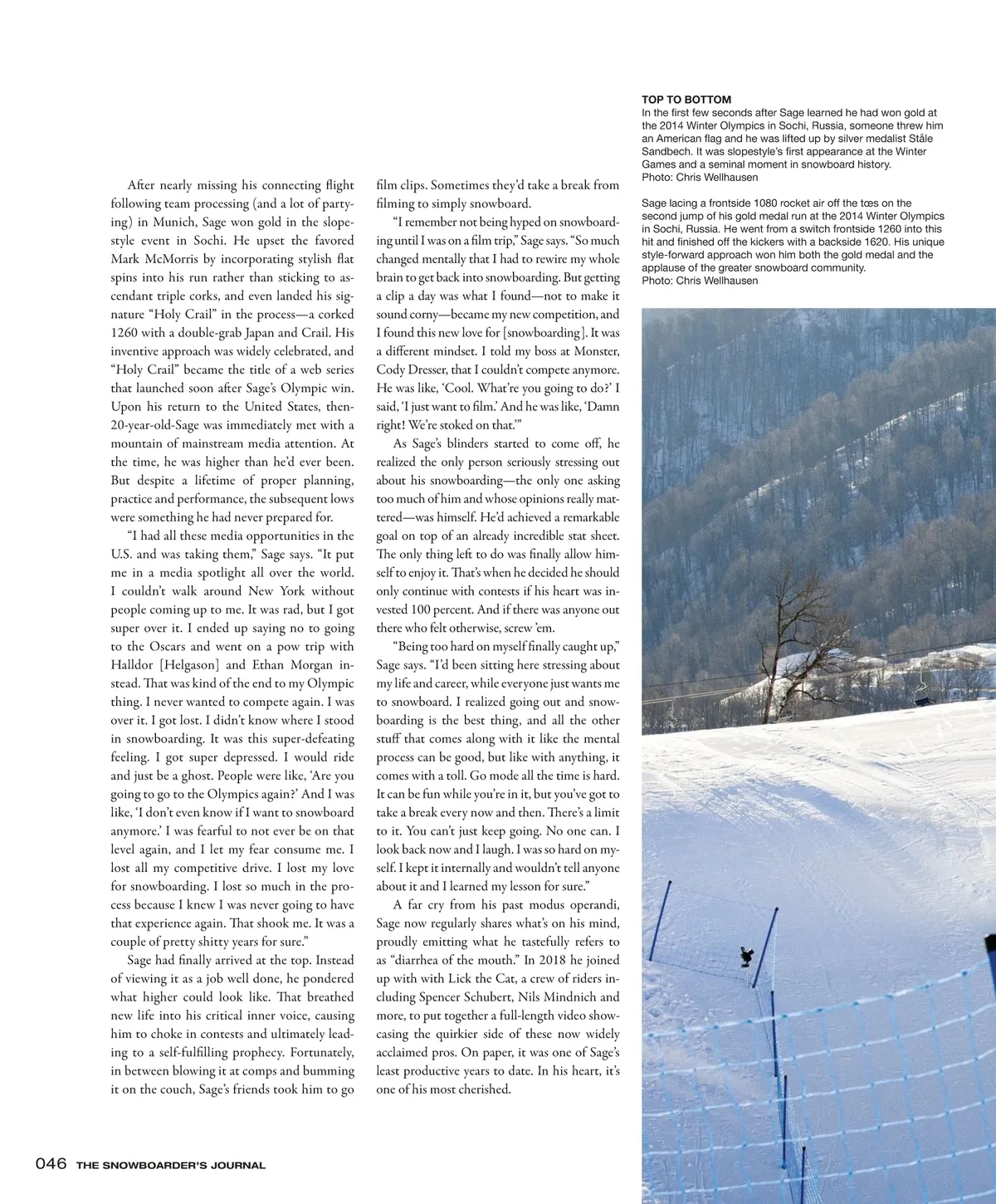
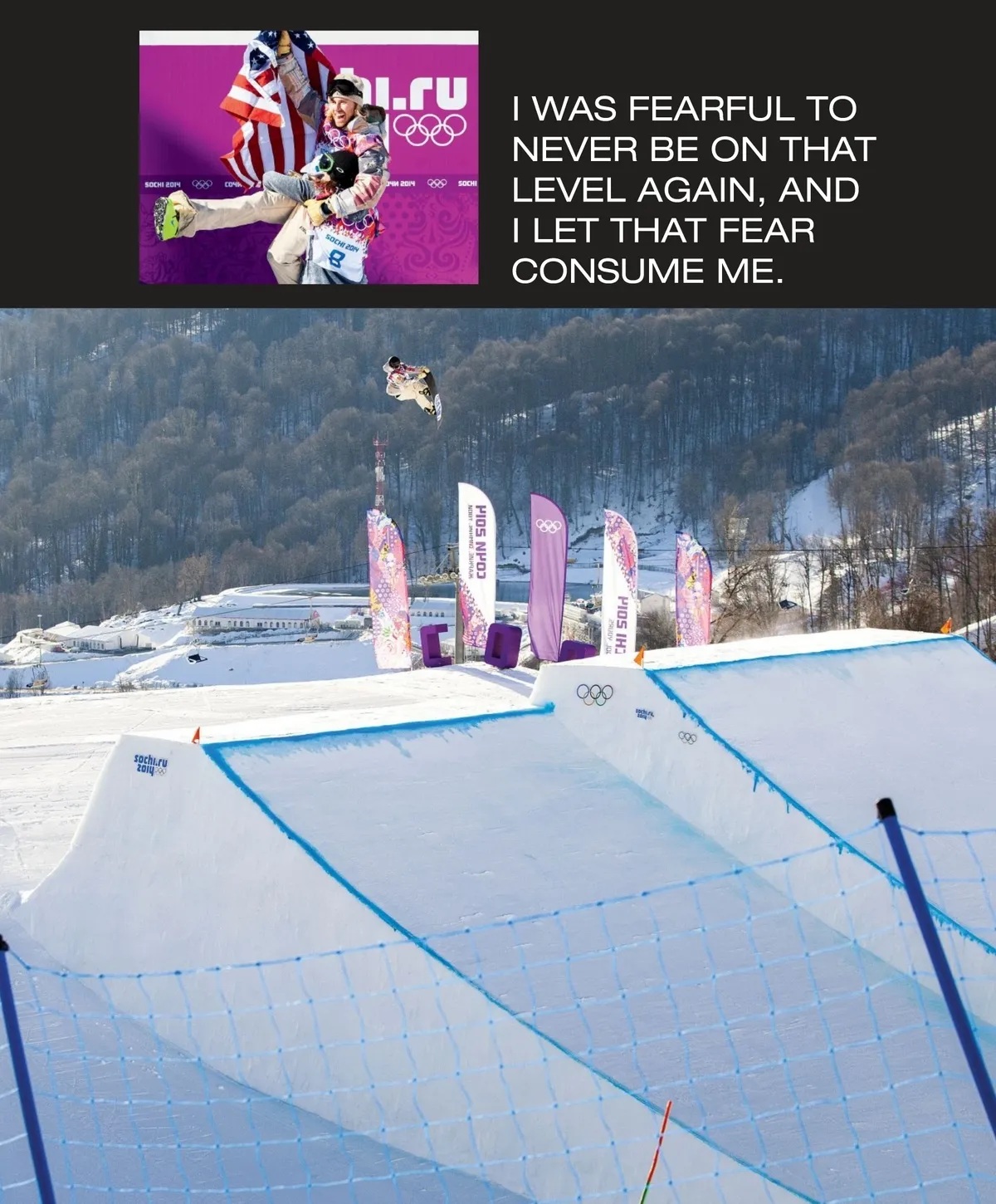
After nearly missing his connecting flight following team processing (and a lot of party-ing) in Munich, Sage won gold in the slope-style event in Sochi. He upset the favored Mark McMorris by incorporating stylish flat spins into his run rather than sticking to as-cendant triple corks, and even landed his sig-nature “Holy Crail” in the process—a corked 1260 with a double-grab Japan and Crail. His inventive approach was widely celebrated, and “Holy Crail” became the title of a web series that launched soon after Sage’s Olympic win. Upon his return to the United States, then-20-year-old-Sage was immediately met with a mountain of mainstream media attention. At the time, he was higher than he’d ever been. But despite a lifetime of proper planning, practice and performance, the subsequent lows were something he had never prepared for. “I had all these media opportunities in the U.S. and was taking them,” Sage says. “It put me in a media spotlight all over the world. I couldn’t walk around New York without people coming up to me. It was rad, but I got super over it. I ended up saying no to going to the Oscars and went on a pow trip with Halldor [Helgason] and Ethan Morgan in-stead. That was kind of the end to my Olympic thing. I never wanted to compete again. I was over it. I got lost. I didn’t know where I stood in snowboarding. It was this super-defeating feeling. I got super depressed. I would ride and just be a ghost. People were like, ‘Are you going to go to the Olympics again?’ And I was like, ‘I don’t even know if I want to snowboard anymore.’ I was fearful to not ever be on that level again, and I let my fear consume me. I lost all my competitive drive. I lost my love for snowboarding. I lost so much in the pro-cess because I knew I was never going to have that experience again. That shook me. It was a couple of pretty shitty years for sure.” Sage had finally arrived at the top. Instead of viewing it as a job well done, he pondered what higher could look like. That breathed new life into his critical inner voice, causing him to choke in contests and ultimately lead-ing to a self-fulfilling prophecy. Fortunately, in between blowing it at comps and bumming it on the couch, Sage’s friends took him to go film clips. Sometimes they’d take a break from filming to simply snowboard. “I remember not being hyped on snowboard-ing until I was on a film trip,” Sage says. “So much changed mentally that I had to rewire my whole brain to get back into snowboarding. But getting a clip a day was what I found—not to make it sound corny—became my new competition, and I found this new love for [snowboarding]. It was a different mindset. I told my boss at Monster, Cody Dresser, that I couldn’t compete anymore. He was like, ‘Cool. What’re you going to do?’ I said, ‘I just want to film.’ And he was like, ‘Damn right! We’re stoked on that.’” As Sage’s blinders started to come off, he realized the only person seriously stressing out about his snowboarding—the only one asking too much of him and whose opinions really mat-tered—was himself. He’d achieved a remarkable goal on top of an already incredible stat sheet. The only thing left to do was finally allow him-self to enjoy it. That’s when he decided he should only continue with contests if his heart was in-vested 100 percent. And if there was anyone out there who felt otherwise, screw ’em. “Being too hard on myself finally caught up,” Sage says. “I’d been sitting here stressing about my life and career, while everyone just wants me to snowboard. I realized going out and snow-boarding is the best thing, and all the other stuff that comes along with it like the mental process can be good, but like with anything, it comes with a toll. Go mode all the time is hard. It can be fun while you’re in it, but you’ve got to take a break every now and then. There’s a limit to it. You can’t just keep going. No one can. I look back now and I laugh. I was so hard on my-self. I kept it internally and wouldn’t tell anyone about it and I learned my lesson for sure.” A far cry from his past modus operandi, Sage now regularly shares what’s on his mind, proudly emitting what he tastefully refers to as “diarrhea of the mouth.” In 2018 he joined up with with Lick the Cat, a crew of riders in-cluding Spencer Schubert, Nils Mindnich and more, to put together a full-length video show-casing the quirkier side of these now widely acclaimed pros. On paper, it was one of Sage’s least productive years to date. In his heart, it’s one of his most cherished. TOP TO BOTTOM In the first few seconds after Sage learned he had won gold at the 2014 Winter Olympics in Sochi, Russia, someone threw him an American flag and he was lifted up by silver medalist Ståle Sandbech. It was slopestyle’s first appearance at the Winter Games and a seminal moment in snowboard history. Photo: Chris Wellhausen Sage lacing a frontside 1080 rocket air off the tœs on the second jump of his gold medal run at the 2014 Winter Olympics in Sochi, Russia. He went from a switch frontside 1260 into this hit and finished off the kickers with a backside 1620. His unique style-forward approach won him both the gold medal and the applause of the greater snowboard community. Photo: Chris Wellhausen 046 THE SNOWBOARDER’S JOURNAL
The Snowboarder's Journal The Snowboarder's Journal 20.3: Page 46