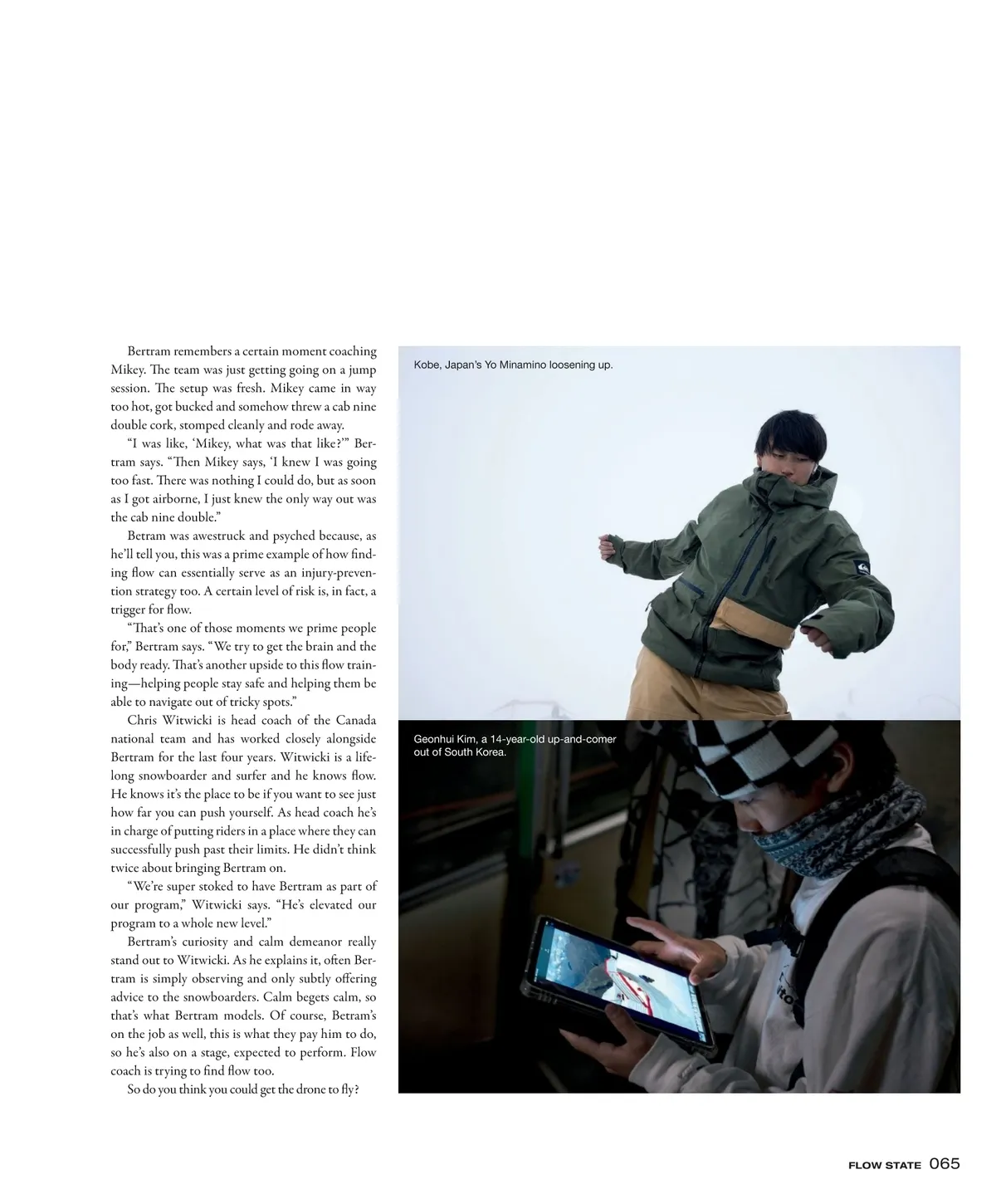
Bertram remembers a certain moment coaching Mikey. The team was just getting going on a jump session. The setup was fresh. Mikey came in way too hot, got bucked and somehow threw a cab nine double cork, stomped cleanly and rode away. “I was like, ‘Mikey, what was that like?’” Ber-tram says. “Then Mikey says, ‘I knew I was going too fast. There was nothing I could do, but as soon as I got airborne, I just knew the only way out was the cab nine double.” Betram was awestruck and psyched because, as he’ll tell you, this was a prime example of how find-ing flow can essentially serve as an injury-preven-tion strategy too. A certain level of risk is, in fact, a trigger for flow. “That’s one of those moments we prime people for,” Bertram says. “We try to get the brain and the body ready. That’s another upside to this flow train-ing—helping people stay safe and helping them be able to navigate out of tricky spots.” Chris Witwicki is head coach of the Canada national team and has worked closely alongside Bertram for the last four years. Witwicki is a life-long snowboarder and surfer and he knows flow. He knows it’s the place to be if you want to see just how far you can push yourself. As head coach he’s in charge of putting riders in a place where they can successfully push past their limits. He didn’t think twice about bringing Bertram on. “We’re super stoked to have Bertram as part of our program,” Witwicki says. “He’s elevated our program to a whole new level.” Bertram’s curiosity and calm demeanor really stand out to Witwicki. As he explains it, often Ber-tram is simply observing and only subtly offering advice to the snowboarders. Calm begets calm, so that’s what Bertram models. Of course, Betram’s on the job as well, this is what they pay him to do, so he’s also on a stage, expected to perform. Flow coach is trying to find flow too. So do you think you could get the drone to fly? Kobe, Japan’s Yo Minamino loosening up. Geonhui Kim, a 14-year-old up-and-comer out of South Korea. FLOW STATE 065
The Snowboarder's Journal The Snowboarder's Journal 20.4: Page 65