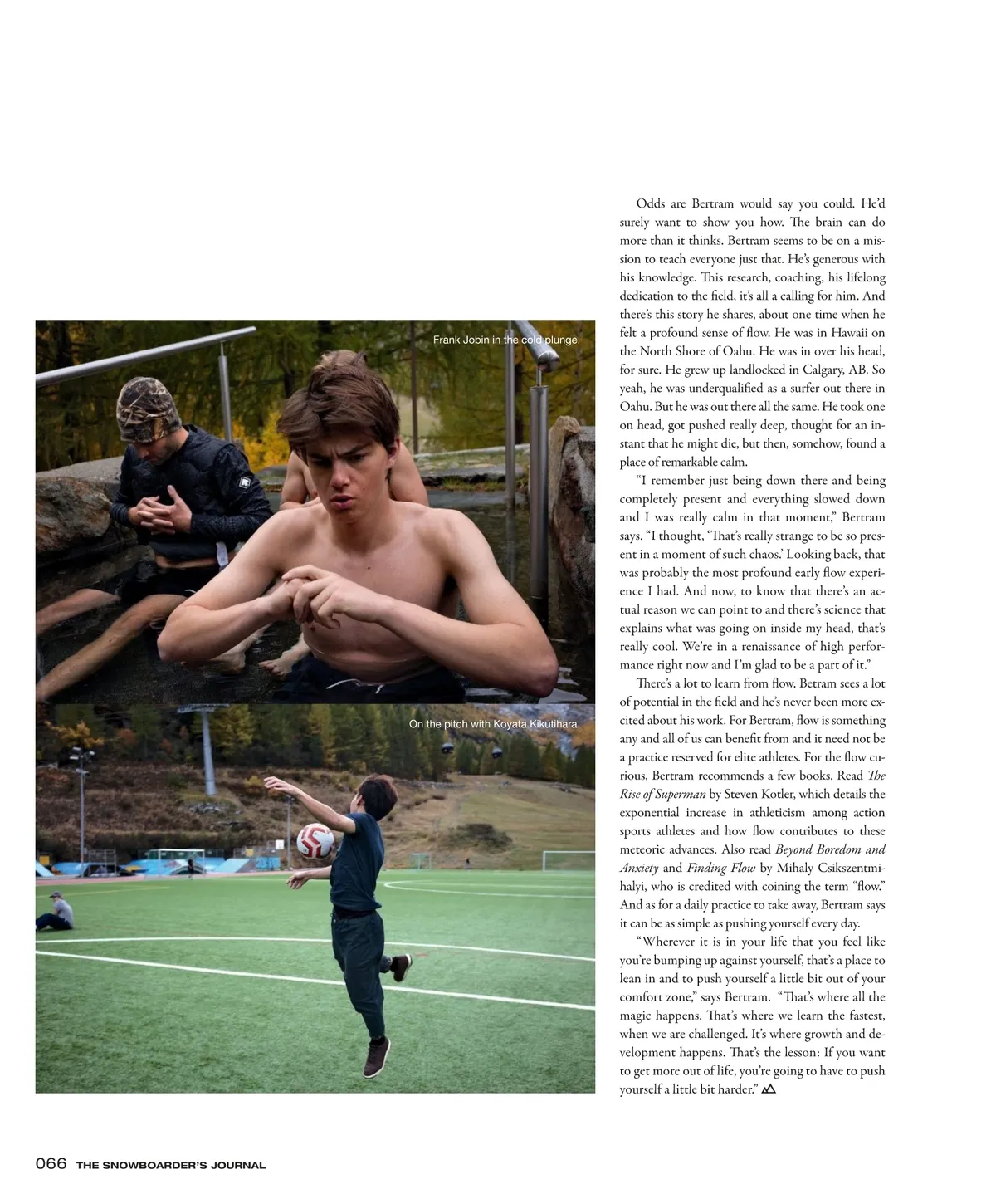
Frank Jobin in the cold plunge. On the pitch with Koyata Kikutihara. Odds are Bertram would say you could. He’d surely want to show you how. The brain can do more than it thinks. Bertram seems to be on a mis-sion to teach everyone just that. He’s generous with his knowledge. This research, coaching, his lifelong dedication to the field, it’s all a calling for him. And there’s this story he shares, about one time when he felt a profound sense of flow. He was in Hawaii on the North Shore of Oahu. He was in over his head, for sure. He grew up landlocked in Calgary, AB. So yeah, he was underqualified as a surfer out there in Oahu. But he was out there all the same. He took one on head, got pushed really deep, thought for an in-stant that he might die, but then, somehow, found a place of remarkable calm. “I remember just being down there and being completely present and everything slowed down and I was really calm in that moment,” Bertram says. “I thought, ‘That’s really strange to be so pres-ent in a moment of such chaos.’ Looking back, that was probably the most profound early flow experi-ence I had. And now, to know that there’s an ac-tual reason we can point to and there’s science that explains what was going on inside my head, that’s really cool. We’re in a renaissance of high perfor-mance right now and I’m glad to be a part of it.” There’s a lot to learn from flow. Betram sees a lot of potential in the field and he’s never been more ex-cited about his work. For Bertram, flow is something any and all of us can benefit from and it need not be a practice reserved for elite athletes. For the flow cu-rious, Bertram recommends a few books. Read The Rise of Superman by Steven Kotler, which details the exponential increase in athleticism among action sports athletes and how flow contributes to these meteoric advances. Also read Beyond Boredom and Anxiety and Finding Flow by Mihaly Csikszentmi-halyi, who is credited with coining the term “flow.” And as for a daily practice to take away, Bertram says it can be as simple as pushing yourself every day. “Wherever it is in your life that you feel like you’re bumping up against yourself, that’s a place to lean in and to push yourself a little bit out of your comfort zone,” says Bertram. “That’s where all the magic happens. That’s where we learn the fastest, when we are challenged. It’s where growth and de-velopment happens. That’s the lesson: If you want to get more out of life, you’re going to have to push yourself a little bit harder.” 066 THE SNOWBOARDER’S JOURNAL
The Snowboarder's Journal The Snowboarder's Journal 20.4: Page 66