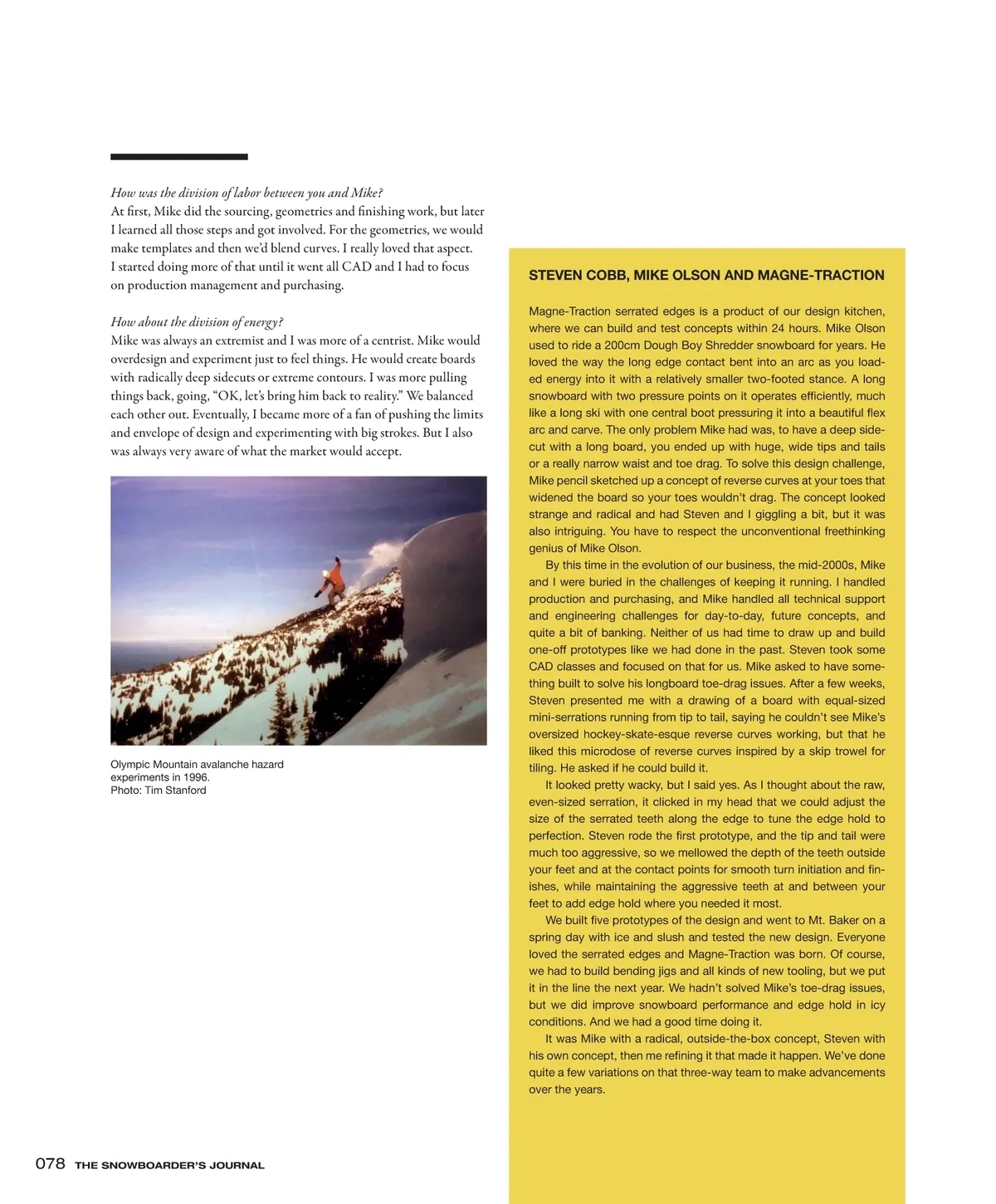
How was the division of labor between you and Mike? At first, Mike did the sourcing, geometries and finishing work, but later I learned all those steps and got involved. For the geometries, we would make templates and then we’d blend curves. I really loved that aspect. I started doing more of that until it went all CAD and I had to focus on production management and purchasing. How about the division of energy? Mike was always an extremist and I was more of a centrist. Mike would overdesign and experiment just to feel things. He would create boards with radically deep sidecuts or extreme contours. I was more pulling things back, going, “OK, let’s bring him back to reality.” We balanced each other out. Eventually, I became more of a fan of pushing the limits and envelope of design and experimenting with big strokes. But I also was always very aware of what the market would accept. STEVEN COBB, MIKE OLSON AND MAGNE-TRACTION Magne-Traction serrated edges is a product of our design kitchen, where we can build and test concepts within 24 hours. Mike Olson used to ride a 200cm Dough Boy Shredder snowboard for years. He loved the way the long edge contact bent into an arc as you load-ed energy into it with a relatively smaller two-footed stance. A long snowboard with two pressure points on it operates efficiently, much like a long ski with one central boot pressuring it into a beautiful flex arc and carve. The only problem Mike had was, to have a deep side-cut with a long board, you ended up with huge, wide tips and tails or a really narrow waist and toe drag. To solve this design challenge, Mike pencil sketched up a concept of reverse curves at your toes that widened the board so your toes wouldn’t drag. The concept looked strange and radical and had Steven and I giggling a bit, but it was also intriguing. You have to respect the unconventional freethinking genius of Mike Olson. By this time in the evolution of our business, the mid-2000s, Mike and I were buried in the challenges of keeping it running. I handled production and purchasing, and Mike handled all technical support and engineering challenges for day-to-day, future concepts, and quite a bit of banking. Neither of us had time to draw up and build one-off prototypes like we had done in the past. Steven took some CAD classes and focused on that for us. Mike asked to have some-thing built to solve his longboard toe-drag issues. After a few weeks, Steven presented me with a drawing of a board with equal-sized mini-serrations running from tip to tail, saying he couldn’t see Mike’s oversized hockey-skate-esque reverse curves working, but that he liked this microdose of reverse curves inspired by a skip trowel for tiling. He asked if he could build it. It looked pretty wacky, but I said yes. As I thought about the raw, even-sized serration, it clicked in my head that we could adjust the size of the serrated teeth along the edge to tune the edge hold to perfection. Steven rode the first prototype, and the tip and tail were much too aggressive, so we mellowed the depth of the teeth outside your feet and at the contact points for smooth turn initiation and fin-ishes, while maintaining the aggressive teeth at and between your feet to add edge hold where you needed it most. We built five prototypes of the design and went to Mt. Baker on a spring day with ice and slush and tested the new design. Everyone loved the serrated edges and Magne-Traction was born. Of course, we had to build bending jigs and all kinds of new tooling, but we put it in the line the next year. We hadn’t solved Mike’s toe-drag issues, but we did improve snowboard performance and edge hold in icy conditions. And we had a good time doing it. It was Mike with a radical, outside-the-box concept, Steven with his own concept, then me refining it that made it happen. We’ve done quite a few variations on that three-way team to make advancements over the years. Olympic Mountain avalanche hazard experiments in 1996. Photo: Tim Stanford 078 THE SNOWBOARDER’S JOURNAL
The Snowboarder's Journal The Snowboarder's Journal 20.4: Page 78