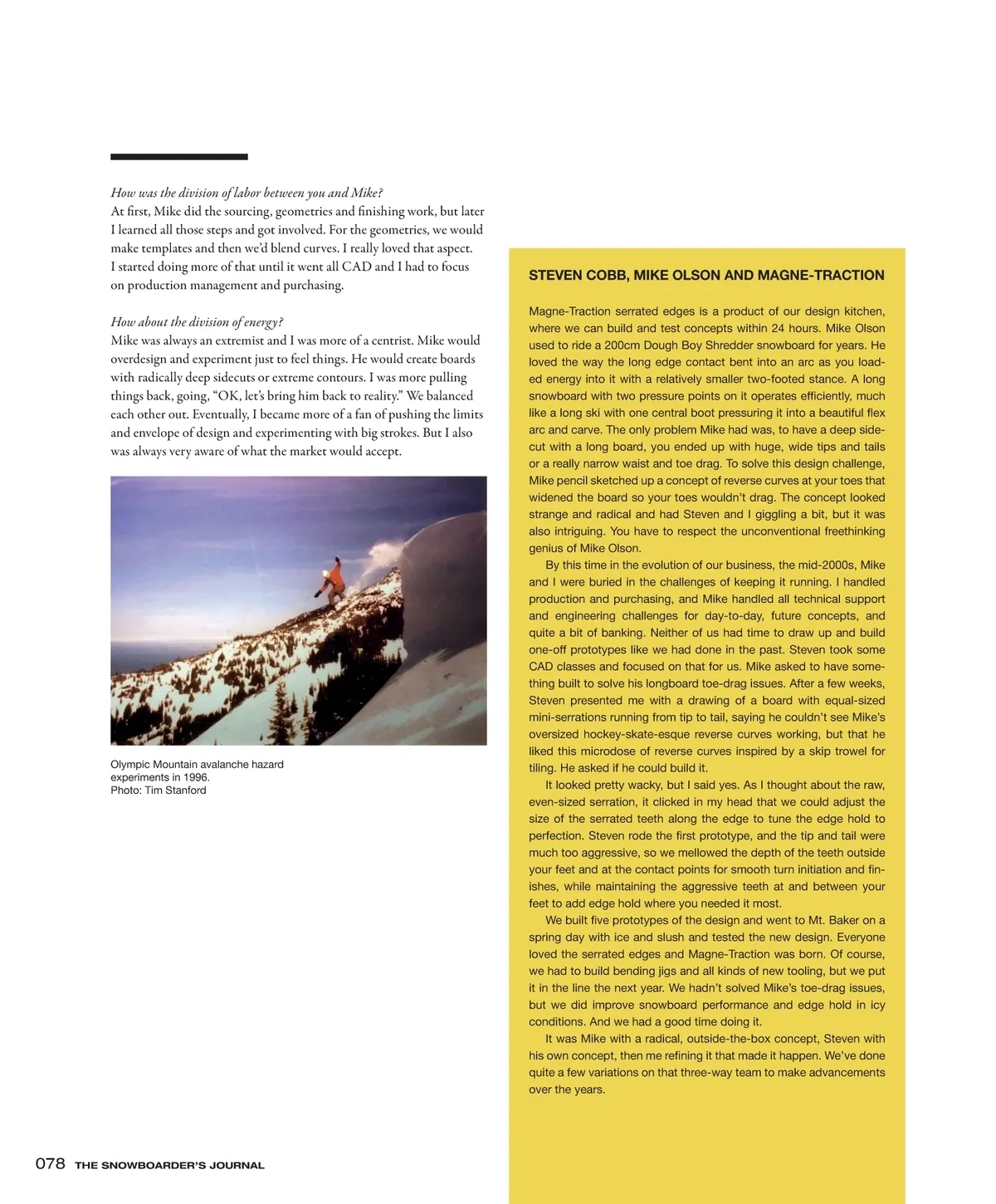
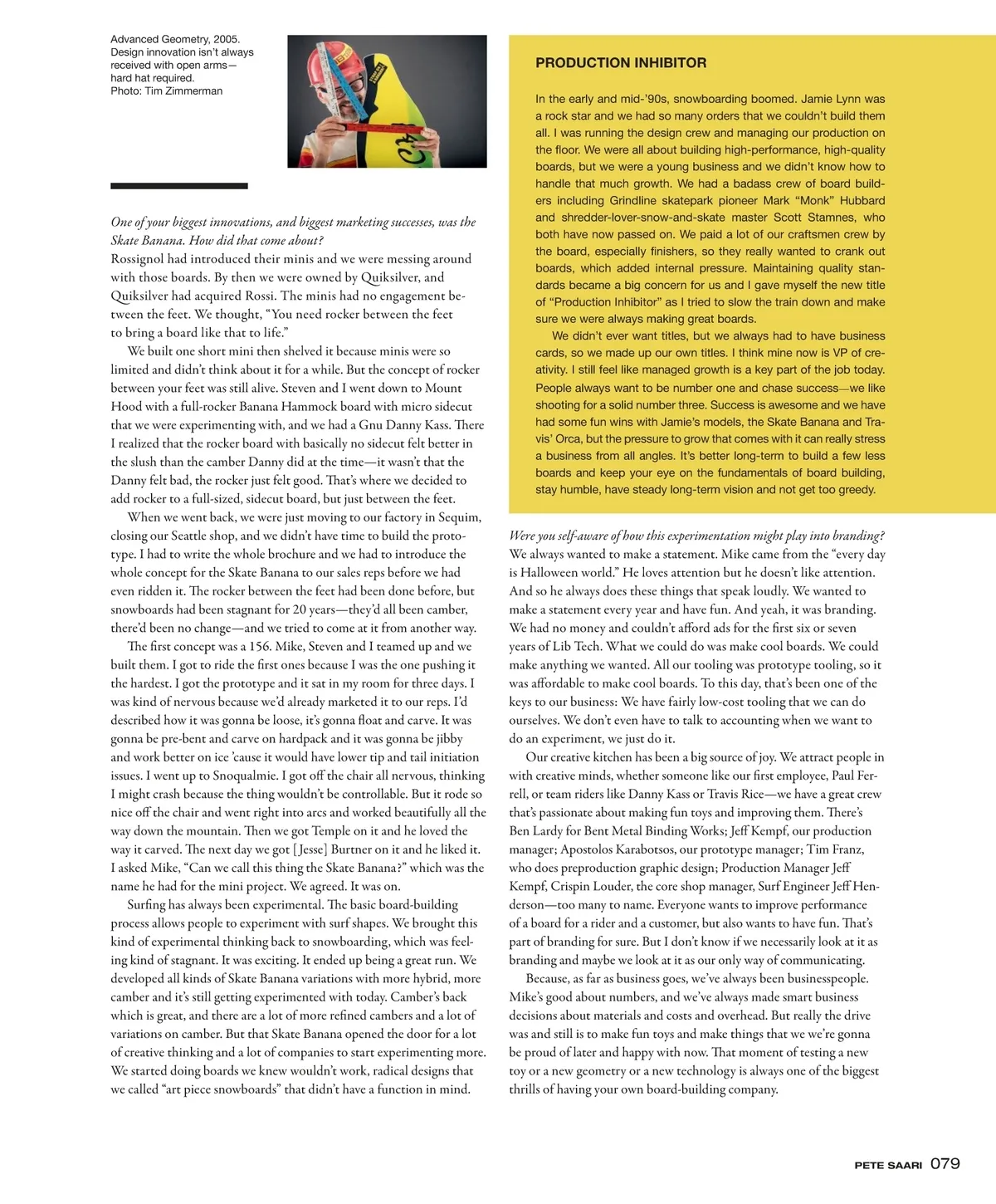
Advanced Geometry, 2005. Design innovation isn’t always received with open arms— hard hat required. Photo: Tim Zimmerman PRODUCTION INHIBITOR In the early and mid-’90s, snowboarding boomed. Jamie Lynn was a rock star and we had so many orders that we couldn’t build them all. I was running the design crew and managing our production on the floor. We were all about building high-performance, high-quality boards, but we were a young business and we didn’t know how to handle that much growth. We had a badass crew of board build-ers including Grindline skatepark pioneer Mark “Monk” Hubbard and shredder-lover-snow-and-skate master Scott Stamnes, who both have now passed on. We paid a lot of our craftsmen crew by the board, especially finishers, so they really wanted to crank out boards, which added internal pressure. Maintaining quality stan-dards became a big concern for us and I gave myself the new title of “Production Inhibitor” as I tried to slow the train down and make sure we were always making great boards. We didn’t ever want titles, but we always had to have business cards, so we made up our own titles. I think mine now is VP of cre-ativity. I still feel like managed growth is a key part of the job today. People always want to be number one and chase success — we like shooting for a solid number three. Success is awesome and we have had some fun wins with Jamie’s models, the Skate Banana and Tra-vis’ Orca, but the pressure to grow that comes with it can really stress a business from all angles. It’s better long-term to build a few less boards and keep your eye on the fundamentals of board building, stay humble, have steady long-term vision and not get too greedy. One of your biggest innovations, and biggest marketing successes, was the Skate Banana. How did that come about? Rossignol had introduced their minis and we were messing around with those boards. By then we were owned by Quiksilver, and Quiksilver had acquired Rossi. The minis had no engagement be-tween the feet. We thought, “You need rocker between the feet to bring a board like that to life.” We built one short mini then shelved it because minis were so limited and didn’t think about it for a while. But the concept of rocker between your feet was still alive. Steven and I went down to Mount Hood with a full-rocker Banana Hammock board with micro sidecut that we were experimenting with, and we had a Gnu Danny Kass. There I realized that the rocker board with basically no sidecut felt better in the slush than the camber Danny did at the time—it wasn’t that the Danny felt bad, the rocker just felt good. That’s where we decided to add rocker to a full-sized, sidecut board, but just between the feet. When we went back, we were just moving to our factory in Sequim, closing our Seattle shop, and we didn’t have time to build the proto-type. I had to write the whole brochure and we had to introduce the whole concept for the Skate Banana to our sales reps before we had even ridden it. The rocker between the feet had been done before, but snowboards had been stagnant for 20 years—they’d all been camber, there’d been no change—and we tried to come at it from another way. The first concept was a 156. Mike, Steven and I teamed up and we built them. I got to ride the first ones because I was the one pushing it the hardest. I got the prototype and it sat in my room for three days. I was kind of nervous because we’d already marketed it to our reps. I’d described how it was gonna be loose, it’s gonna float and carve. It was gonna be pre-bent and carve on hardpack and it was gonna be jibby and work better on ice ’cause it would have lower tip and tail initiation issues. I went up to Snoqualmie. I got off the chair all nervous, thinking I might crash because the thing wouldn’t be controllable. But it rode so nice off the chair and went right into arcs and worked beautifully all the way down the mountain. Then we got Temple on it and he loved the way it carved. The next day we got [ Jesse] Burtner on it and he liked it. I asked Mike, “Can we call this thing the Skate Banana?” which was the name he had for the mini project. We agreed. It was on. Surfing has always been experimental. The basic board-building process allows people to experiment with surf shapes. We brought this kind of experimental thinking back to snowboarding, which was feel-ing kind of stagnant. It was exciting. It ended up being a great run. We developed all kinds of Skate Banana variations with more hybrid, more camber and it’s still getting experimented with today. Camber’s back which is great, and there are a lot of more refined cambers and a lot of variations on camber. But that Skate Banana opened the door for a lot of creative thinking and a lot of companies to start experimenting more. We started doing boards we knew wouldn’t work, radical designs that we called “art piece snowboards” that didn’t have a function in mind. Were you self-aware of how this experimentation might play into branding? We always wanted to make a statement. Mike came from the “every day is Halloween world.” He loves attention but he doesn’t like attention. And so he always does these things that speak loudly. We wanted to make a statement every year and have fun. And yeah, it was branding. We had no money and couldn’t afford ads for the first six or seven years of Lib Tech. What we could do was make cool boards. We could make anything we wanted. All our tooling was prototype tooling, so it was affordable to make cool boards. To this day, that’s been one of the keys to our business: We have fairly low-cost tooling that we can do ourselves. We don’t even have to talk to accounting when we want to do an experiment, we just do it. Our creative kitchen has been a big source of joy. We attract people in with creative minds, whether someone like our first employee, Paul Fer-rell, or team riders like Danny Kass or Travis Rice—we have a great crew that’s passionate about making fun toys and improving them. There’s Ben Lardy for Bent Metal Binding Works; Jeff Kempf, our production manager; Apostolos Karabotsos, our prototype manager; Tim Franz, who does preproduction graphic design; Production Manager Jeff Kempf, Crispin Louder, the core shop manager, Surf Engineer Jeff Hen-derson—too many to name. Everyone wants to improve performance of a board for a rider and a customer, but also wants to have fun. That’s part of branding for sure. But I don’t know if we necessarily look at it as branding and maybe we look at it as our only way of communicating. Because, as far as business goes, we’ve always been businesspeople. Mike’s good about numbers, and we’ve always made smart business decisions about materials and costs and overhead. But really the drive was and still is to make fun toys and make things that we we’re gonna be proud of later and happy with now. That moment of testing a new toy or a new geometry or a new technology is always one of the biggest thrills of having your own board-building company. PETE SAARI 079
The Snowboarder's Journal The Snowboarder's Journal 20.4: Page 79