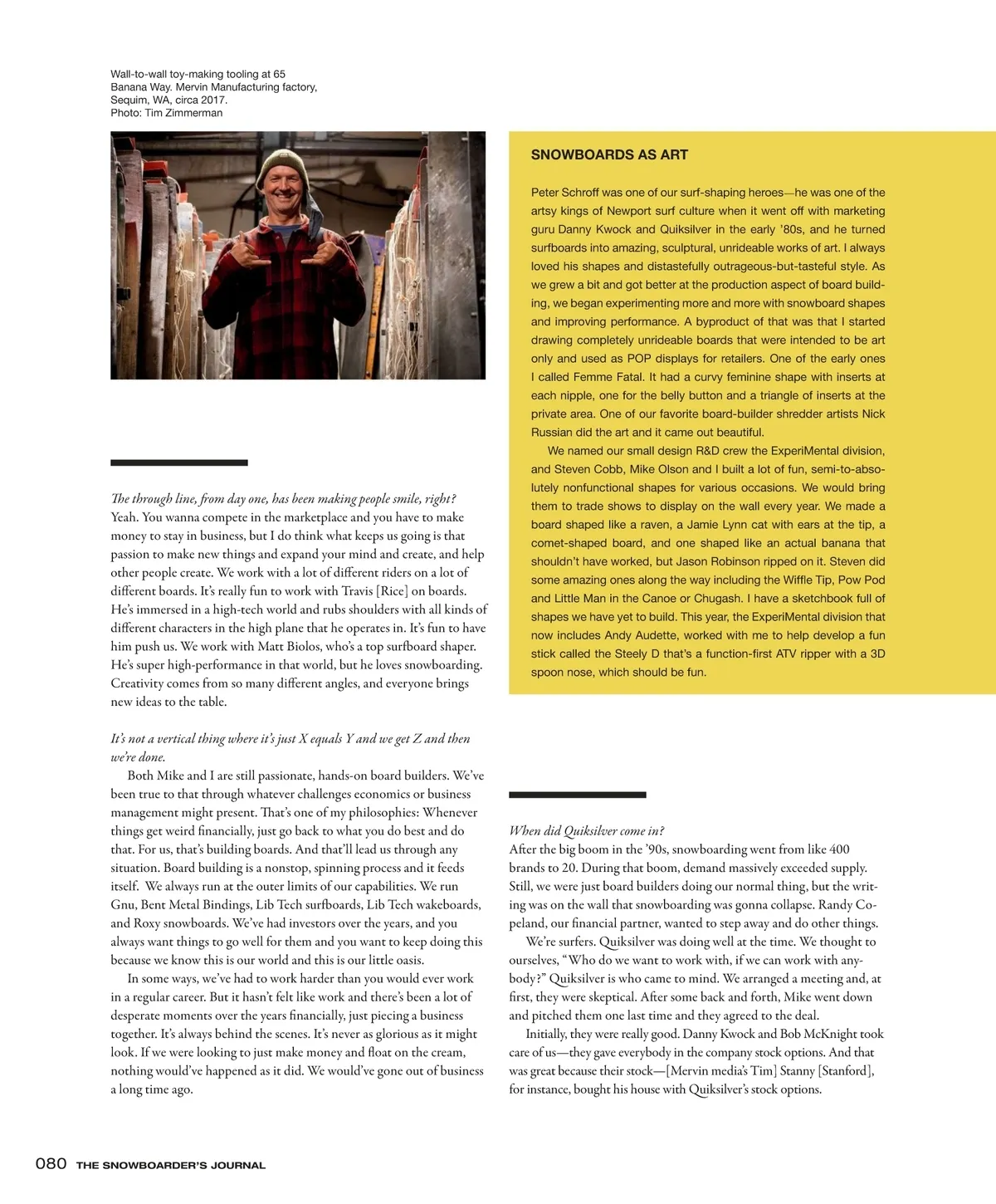
Wall-to-wall toy-making tooling at 65 Banana Way. Mervin Manufacturing factory, Sequim, WA, circa 2017. Photo: Tim Zimmerman SNOWBOARDS AS ART Peter Schroff was one of our surf-shaping heroes — he was one of the artsy kings of Newport surf culture when it went off with marketing guru Danny Kwock and Quiksilver in the early ’80s, and he turned surfboards into amazing, sculptural, unrideable works of art. I always loved his shapes and distastefully outrageous-but-tasteful style. As we grew a bit and got better at the production aspect of board build-ing, we began experimenting more and more with snowboard shapes and improving performance. A byproduct of that was that I started drawing completely unrideable boards that were intended to be art only and used as POP displays for retailers. One of the early ones I called Femme Fatal. It had a curvy feminine shape with inserts at each nipple, one for the belly button and a triangle of inserts at the private area. One of our favorite board-builder shredder artists Nick Russian did the art and it came out beautiful. We named our small design R&D crew the ExperiMental division, and Steven Cobb, Mike Olson and I built a lot of fun, semi-to-abso-lutely nonfunctional shapes for various occasions. We would bring them to trade shows to display on the wall every year. We made a board shaped like a raven, a Jamie Lynn cat with ears at the tip, a comet-shaped board, and one shaped like an actual banana that shouldn’t have worked, but Jason Robinson ripped on it. Steven did some amazing ones along the way including the Wiffle Tip, Pow Pod and Little Man in the Canoe or Chugash. I have a sketchbook full of shapes we have yet to build. This year, the ExperiMental division that now includes Andy Audette, worked with me to help develop a fun stick called the Steely D that’s a function-first ATV ripper with a 3D spoon nose, which should be fun. The through line, from day one, has been making people smile, right? Yeah. You wanna compete in the marketplace and you have to make money to stay in business, but I do think what keeps us going is that passion to make new things and expand your mind and create, and help other people create. We work with a lot of different riders on a lot of different boards. It’s really fun to work with Travis [Rice] on boards. He’s immersed in a high-tech world and rubs shoulders with all kinds of different characters in the high plane that he operates in. It’s fun to have him push us. We work with Matt Biolos, who’s a top surfboard shaper. He’s super high-performance in that world, but he loves snowboarding. Creativity comes from so many different angles, and everyone brings new ideas to the table. It’s not a vertical thing where it’s just X equals Y and we get Z and then we’re done. Both Mike and I are still passionate, hands-on board builders. We’ve been true to that through whatever challenges economics or business management might present. That’s one of my philosophies: Whenever things get weird financially, just go back to what you do best and do that. For us, that’s building boards. And that’ll lead us through any situation. Board building is a nonstop, spinning process and it feeds itself. We always run at the outer limits of our capabilities. We run Gnu, Bent Metal Bindings, Lib Tech surfboards, Lib Tech wakeboards, and Roxy snowboards. We’ve had investors over the years, and you always want things to go well for them and you want to keep doing this because we know this is our world and this is our little oasis. In some ways, we’ve had to work harder than you would ever work in a regular career. But it hasn’t felt like work and there’s been a lot of desperate moments over the years financially, just piecing a business together. It’s always behind the scenes. It’s never as glorious as it might look. If we were looking to just make money and float on the cream, nothing would’ve happened as it did. We would’ve gone out of business a long time ago. When did Quiksilver come in? After the big boom in the ’90s, snowboarding went from like 400 brands to 20. During that boom, demand massively exceeded supply. Still, we were just board builders doing our normal thing, but the writ-ing was on the wall that snowboarding was gonna collapse. Randy Co-peland, our financial partner, wanted to step away and do other things. We’re surfers. Quiksilver was doing well at the time. We thought to ourselves, “Who do we want to work with, if we can work with any-body?” Quiksilver is who came to mind. We arranged a meeting and, at first, they were skeptical. After some back and forth, Mike went down and pitched them one last time and they agreed to the deal. Initially, they were really good. Danny Kwock and Bob McKnight took care of us—they gave everybody in the company stock options. And that was great because their stock—[Mervin media’s Tim] Stanny [Stanford], for instance, bought his house with Quiksilver’s stock options. 080 THE SNOWBOARDER’S JOURNAL
The Snowboarder's Journal The Snowboarder's Journal 20.4: Page 80