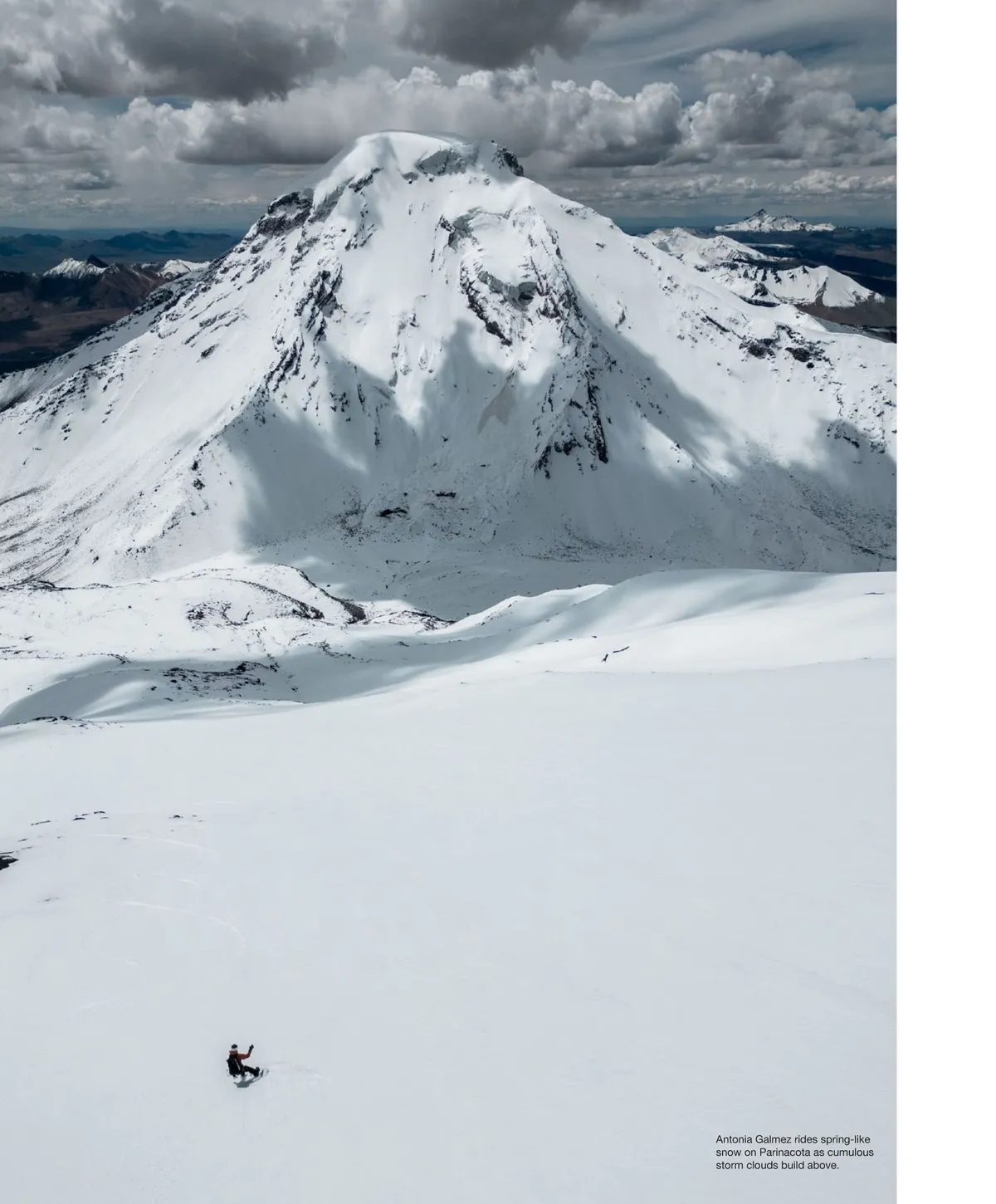
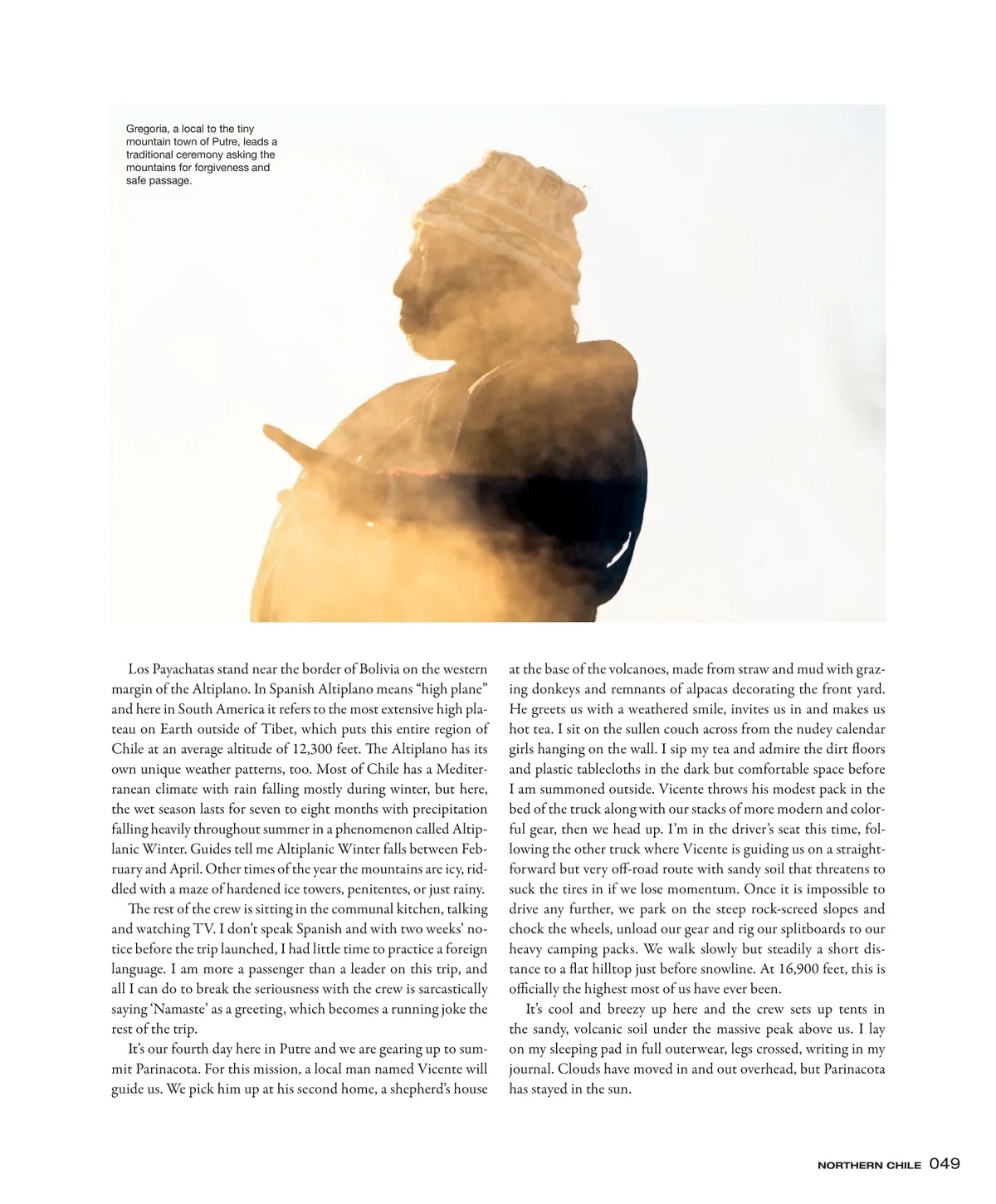
Gregoria, a local to the tiny mountain town of Putre, leads a traditional ceremony asking the mountains for forgiveness and safe passage. Los Payachatas stand near the border of Bolivia on the western margin of the Altiplano. In Spanish Altiplano means “high plane” and here in South America it refers to the most extensive high pla-teau on Earth outside of Tibet, which puts this entire region of Chile at an average altitude of 12,300 feet. The Altiplano has its own unique weather patterns, too. Most of Chile has a Mediter-ranean climate with rain falling mostly during winter, but here, the wet season lasts for seven to eight months with precipitation falling heavily throughout summer in a phenomenon called Altip-lanic Winter. Guides tell me Altiplanic Winter falls between Feb-ruary and April. Other times of the year the mountains are icy, rid-dled with a maze of hardened ice towers, penitentes, or just rainy. The rest of the crew is sitting in the communal kitchen, talking and watching TV. I don’t speak Spanish and with two weeks’ no-tice before the trip launched, I had little time to practice a foreign language. I am more a passenger than a leader on this trip, and all I can do to break the seriousness with the crew is sarcastically saying ‘Namaste’ as a greeting, which becomes a running joke the rest of the trip. It’s our fourth day here in Putre and we are gearing up to sum-mit Parinacota. For this mission, a local man named Vicente will guide us. We pick him up at his second home, a shepherd’s house at the base of the volcanoes, made from straw and mud with graz-ing donkeys and remnants of alpacas decorating the front yard. He greets us with a weathered smile, invites us in and makes us hot tea. I sit on the sullen couch across from the nudey calendar girls hanging on the wall. I sip my tea and admire the dirt floors and plastic tablecloths in the dark but comfortable space before I am summoned outside. Vicente throws his modest pack in the bed of the truck along with our stacks of more modern and color-ful gear, then we head up. I’m in the driver’s seat this time, fol-lowing the other truck where Vicente is guiding us on a straight-forward but very off-road route with sandy soil that threatens to suck the tires in if we lose momentum. Once it is impossible to drive any further, we park on the steep rock-screed slopes and chock the wheels, unload our gear and rig our splitboards to our heavy camping packs. We walk slowly but steadily a short dis-tance to a flat hilltop just before snowline. At 16,900 feet, this is officially the highest most of us have ever been. It’s cool and breezy up here and the crew sets up tents in the sandy, volcanic soil under the massive peak above us. I lay on my sleeping pad in full outerwear, legs crossed, writing in my journal. Clouds have moved in and out overhead, but Parinacota has stayed in the sun. NORTHERN CHILE 049
The Snowboarder's Journal The Snowboarder's Journal 21.3: Page 49