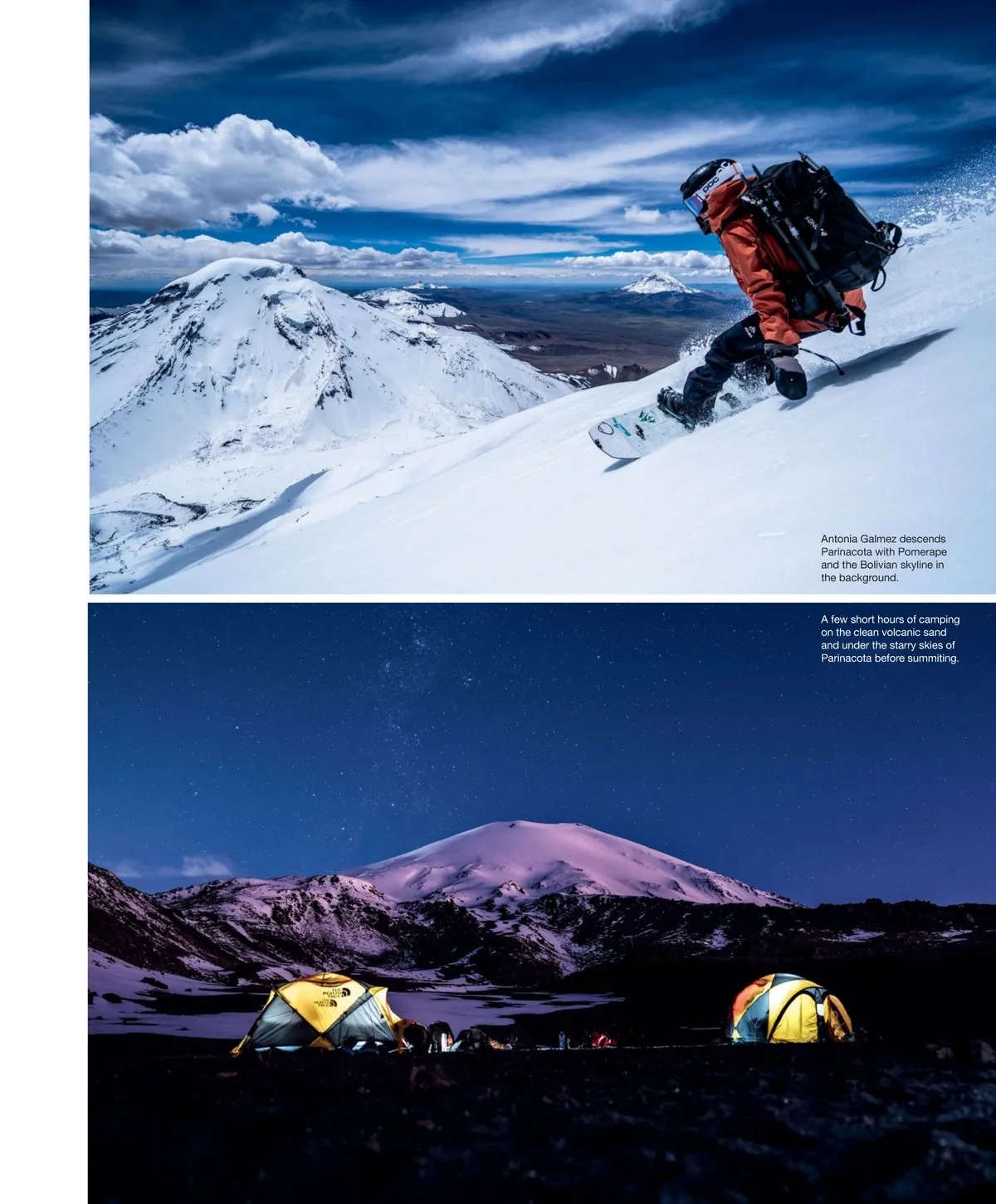
I share a tent with Nelly; we go to bed at 11:30 p.m. and wake only a few hours later at 1:30 a.m., then make hot water for in-stant coffee and tea. We pass around a bag of coca leaves, ibupro-fen and altitude sickness medicine and walk a short distance from the tents to a vein of snow where we strap on our splitboards and begin our ascent under the nearly full moon. I was told this was one of the least light polluted places on the planet and am relieved to be moving around under the shelter of night and stars. The old snow is firm in the cold night, echoing the rhythmic clangs of our splitboard crampons as we walk. The slow and precise pace is in-teresting yet low consequence, the experience enhanced by sleep deprivation, elevation and a mixture of legal drugs. The sun be-gins to rise. I soak in the last bit of the sweet night. It’s a straight-forward and sunny march to the summit, a consistent and non-technical hike. I practice control of my breath and use ‘rest steps,’ completely relaxing all of the muscles in one leg before bringing it forward. Although our acclimatization was rushed, this still feels like a good intro to high-elevation movement. My feet sink into boot-deep snow a few hundred feet from the summit. Anto scurries ahead of me with Victor and we all arrive atop Parinacota after nine hours of hiking. The views from 20,900 feet are striking, especially down into the craggy summit crater. A few puffs of volcanic smoke rise into the arid sky. My throat is torched, and it hurts to speak, so I don’t. I just take in the views of the desert horizon spiked with white-capped volcanoes from here to Bolivia. We change over to snowboard mode and the four of us drop simultaneously. The snow is firm under my board but edge-able and there is no exposure for us to worry about. It’s not steep enough to be dangerous but it’s steep enough to be fun; there are barely any blind rollovers. We weave through a slushy gully bor-dered with walls of volcanic rock. I cruise behind Anto, linking turns until we dead-end at rock scree, unstrap and walk back to our tents. Thunderstorms loom around us so we hurriedly pack up camp to head down. At the truck I hack up thick yellow mucous. SUMMITING POMERAPE is out—the snowpack looks thin and there is far too much steep exposure in marginal snow for our crew. We rest in Putre as a thin layer of snow blankets the high country. We have a ceremony on the edge of town, led by a local woman named Gregoria, who burns brush, tosses shots of liquor over her shoulder, and waves smoke to the mountains, whom she asks to forgive us and provide us strength. When it is my turn to speak, I modestly request a fun passage. It’s day nine here in Putre and again we are packing the trucks up with camping gear. This time we head towards Volcán Taa-pacá, the peak that has been overlooking us from 19,226 feet our whole stay. We drive into the town center where vendors have booths set up with colorful souvenirs and dogs roam about col-larless but clearly at home. We park next to a brick wall topped with baskets of vegetables that block my door from opening. The girls jump out, I assume to go shopping but then realize they are visiting Gregoria’s souvenir stand. Some local women walk up to my open window since we are parked in front of their vegetable stand. They want to sell me some carrots, which look like they would be good hiking snacks and a fair purchase for our parking spot, so I oblige. On a dirt road going towards the mountain, we stop and pick up our guides, Gonzalo and Bastian, who work for a local outfit-ter. They are young, dressed in modern mountaineering gear, and are happy to be joining us. It is starting to feel more like a party as they stuff themselves into the trucks. We aggressively off-road in-between lush green mounds of llareta, a soft, moss-like plant native to the area. I lean out the window taking pictures of the exotic landscape on my point-and-shoot. We arrive at camp on the slope of Volcán Taapacá at 16,000 feet overlooking Putre and the alluvial fan we just rallied up. Nelly and I pick a scenic tent site nestled in the large boulders and sandy wash. We both have our eyes on a smooth apron of snow a short hike above us. We’re itching to snowboard and feel finally free from the confines of the casita. Pato is keen to join as are Bastian and Gonzalo, as they have never seen anyone ski or snowboard this mountain before. They are also excited to be on this side of the mountain as this isn’t the normal ascent route. We hike to the top of the apron, and I focus my attention on an aes-thetic, clean line that starts from the summit. I watch it under the setting sun, mindsurfing and memorizing it turn by turn to ride it tomorrow. We ride to where snow meets rock and head to camp to join the rest of the group. Standing in a circle discussing plans for tomorrow, I ask, “Can we summit?” There is a conversation in Spanish I don’t under-stand before ultimately getting the answer: “No.” We will just go to the West Ridge. Riding off the summit of Taapacá will have to wait for another trip. We wake early and hike up the mountain to the top of the ridge. I feel more alive than I have since leaving North America. I eye a route down, wait for Nelly and Paula to drop first, and watch them both take big smooth turns around the volcanic rock features and out of sight. I drop in and cruise waves and ridges until the debris choke me out onto the apron. The snow here is most interesting, like deep, loose Styrofoam. I weave slow turns in between rocks and savor the moments on my snowboard above the Altiplano. 050 THE SNOWBOARDER’S JOURNAL
The Snowboarder's Journal The Snowboarder's Journal 21.3: Page 50