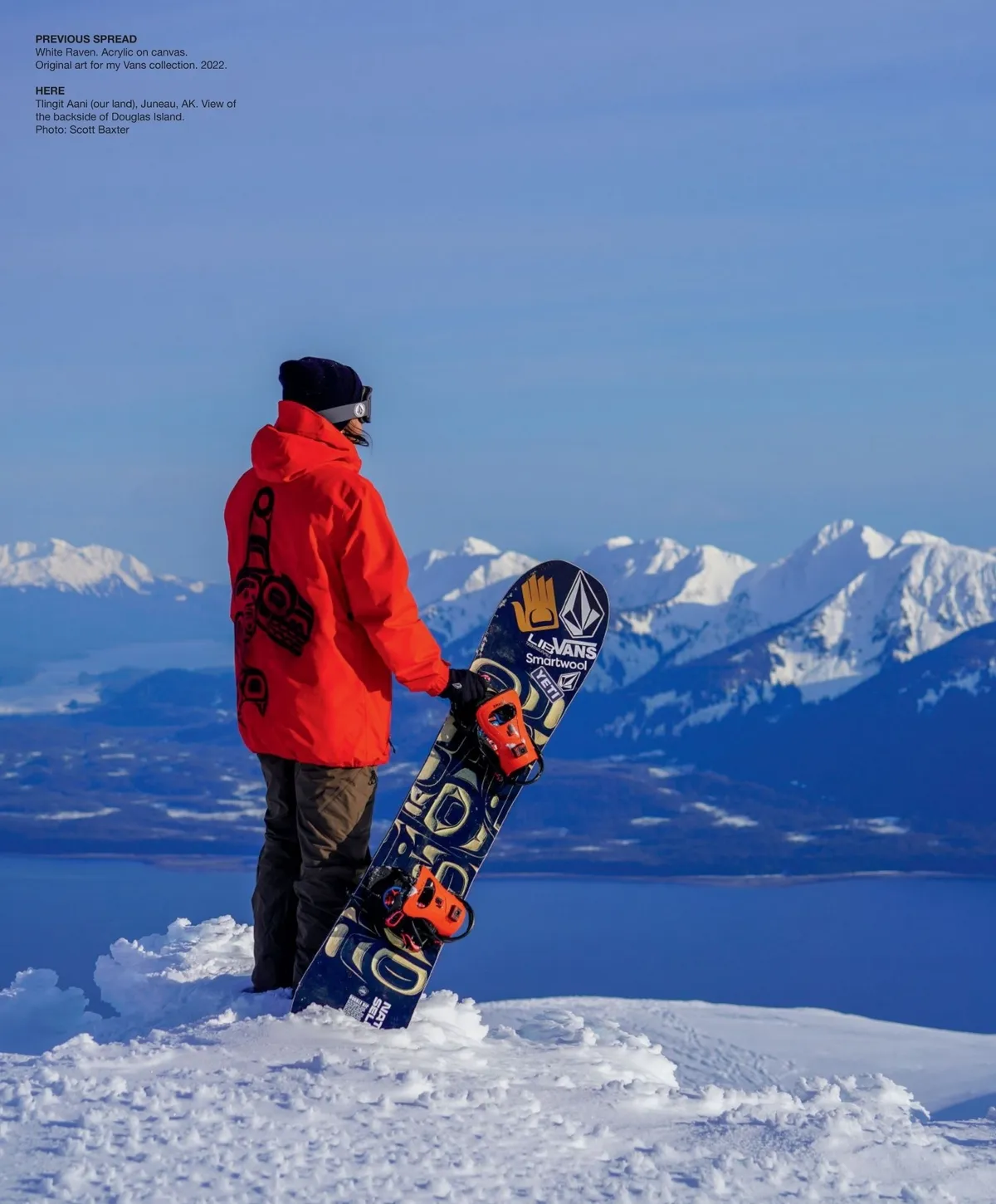
Introduction Liam Gallagher Words James Johnson as told to Liam Gallagher Art and Captions James Johnson ames Johnson learned to snowboard at Eaglecrest just outside Juneau, AK. Snowboarding was it for him early on. Mark Landvik was in the crew then, too. As Lando went on to pro snowboarding, traveled the world and moved to Washington state, he and James always kept in touch. At one point the two of them started trading art for snowboards and vice versa. James got one of Lando’s pro models and Mark got a piece of Tlingit art from James. To this day, James’ masks, paddles and other carvings are dis-played prominently at Mark’s house. J “Honestly, Mark was the first person that really believed in my art and what I was doing as an artist,” James says. As an early patron Mark made lots of introductions for James. He put James’ art in front of his snowboard industry connections and shortly thereafter came collaborations with Lib Tech, Vans, Bent Metal and a slew of others. James started selling original pieces and his list of out-door industry clients grew steadily. In time he began lecturing on Tlingit art and even spoke to employees at Google about it. He’s been teaching at the Port Townsend School of Woodworking for three years. James is now 45 years old and lives in sunny Phoenix. His work is part of the collections at the Heard Museum, Art In-stitute of Chicago, Rhode Island School of Design, Denver Museum of Nature & Science, Burke Museum, Nerman Mu-seum of Contemporary Art and in the Gochman Family Collection in New York City. He’s won various awards at juried art shows around the country and recently his CV has only gotten more impressive: James now works with the United Na-tions, consulting on their approach to relationship building with Indigenous artists around the world. “It’s been like a dream,” he says. “I never really planned or envisioned any of this. It’s all just evolving naturally, and I’m all for it.” James has been working on Tlingit art for 15 years. He’s self-taught; no one showed him the traditions. Although there was a direct line to artists among his ancestors, it was broken by efforts to as-similate Native Alaskans into American culture. So, for James, making art is a ca-reer, but it’s also his way of reconnecting to the past and regaining some of what was lost for the Tlingit people. As he puts it, “What I do these days is so much bigger than just trying to create something that looks pretty.” Here is James’ story, in his own words. JAMES JOHNSON 085
The Snowboarder's Journal The Snowboarder's Journal 21.4: Page 85