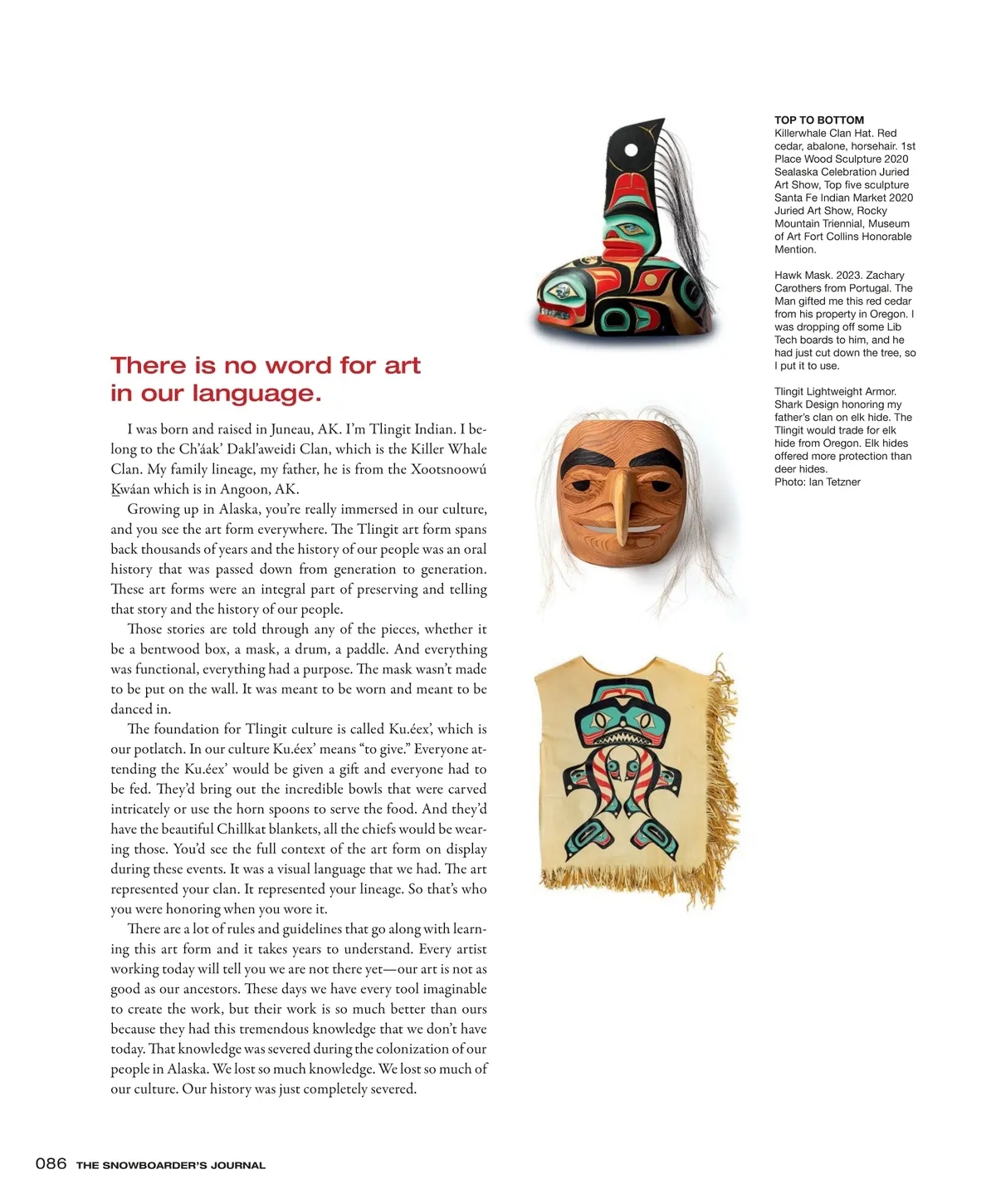
TOP TO BOTTOM Killerwhale Clan Hat. Red cedar, abalone, horsehair. 1st Place Wood Sculpture 2020 Sealaska Celebration Juried Art Show, Top five sculpture Santa Fe Indian Market 2020 Juried Art Show, Rocky Mountain Triennial, Museum of Art Fort Collins Honorable Mention. Hawk Mask. 2023. Zachary Carothers from Portugal. The Man gifted me this red cedar from his property in Oregon. I was dropping off some Lib Tech boards to him, and he had just cut down the tree, so I put it to use. Tlingit Lightweight Armor. Shark Design honoring my father’s clan on elk hide. The Tlingit would trade for elk hide from Oregon. Elk hides offered more protection than deer hides. Photo: Ian Tetzner There is no word for art in our language. I was born and raised in Juneau, AK. I’m Tlingit Indian. I be-long to the Ch’áak’ Dakl’aweidi Clan, which is the Killer Whale Clan. My family lineage, my father, he is from the Xootsnoowú Kwáan which is in Angoon, AK. Growing up in Alaska, you’re really immersed in our culture, and you see the art form everywhere. The Tlingit art form spans back thousands of years and the history of our people was an oral history that was passed down from generation to generation. These art forms were an integral part of preserving and telling that story and the history of our people. Those stories are told through any of the pieces, whether it be a bentwood box, a mask, a drum, a paddle. And everything was functional, everything had a purpose. The mask wasn’t made to be put on the wall. It was meant to be worn and meant to be danced in. The foundation for Tlingit culture is called Ku.éex’, which is our potlatch. In our culture Ku.éex’ means “to give.” Everyone at-tending the Ku.éex’ would be given a gift and everyone had to be fed. They’d bring out the incredible bowls that were carved intricately or use the horn spoons to serve the food. And they’d have the beautiful Chillkat blankets, all the chiefs would be wear-ing those. You’d see the full context of the art form on display during these events. It was a visual language that we had. The art represented your clan. It represented your lineage. So that’s who you were honoring when you wore it. There are a lot of rules and guidelines that go along with learn-ing this art form and it takes years to understand. Every artist working today will tell you we are not there yet—our art is not as good as our ancestors. These days we have every tool imaginable to create the work, but their work is so much better than ours because they had this tremendous knowledge that we don’t have today. That knowledge was severed during the colonization of our people in Alaska. We lost so much knowledge. We lost so much of our culture. Our history was just completely severed. 086 THE SNOWBOARDER’S JOURNAL
The Snowboarder's Journal The Snowboarder's Journal 21.4: Page 86